U.S. Government Shutdown & Your Portfolio
Author
What’s happening
The federal government shut down on Wednesday, October 1st, after Congress failed to pass a funding agreement. While the House of Representatives was able to pass a seven-week extension of current spending, the Senate failed to pass the extension as it requires 60 total “yes” votes, not a simple majority.
Hundreds of thousands of federal workers have been furloughed, while others are working without pay. “Essential” services remain open while some agencies either pause operations or operate with considerably less staff. The situation will continue to evolve as contingency funds for each federal agency are depleted.
What government services are affected in a shutdown?
Each federal agency is affected differently during a shutdown, depending on factors such as how essential the services are and how the agency is funded. For example, spending that is considered “Mandatory”, such as Social Security, Medicare, and Medicaid, is not subject to annual appropriations and therefore will continue to be funded. Immigration services are funded by visa fees, so they will also be less affected by the shutdown.
Here is a list of some of the effects you may see:
- Social Security and Medicare: While checks will still be sent, services that include benefit verification and card issuance will stop
- Air Travel: During past shutdowns, some TSA agents and air traffic controllers did not report to work because they were expected to work without pay until the government reopened. This led to longer security lines and temporary airport shutdowns.
- Environmental and Food Inspection: The Environmental Protection Agency (EPA) and Food and Drug Administration (FDA) have historically stopped performing inspections during past shutdowns. This includes EPA inspections on hazardous waste, drinking water, and chemical facilities.
- Non-essential government employees, including some active military personnel, will experience delays in payroll.1
What shutdowns have historically meant for markets
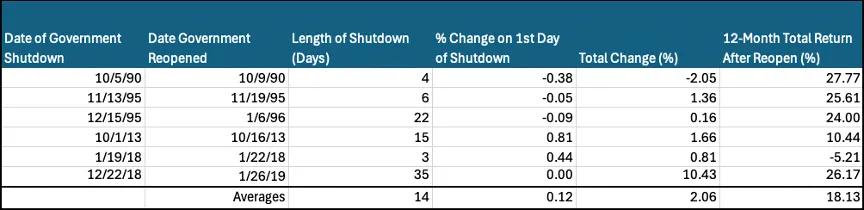
Generally, government shutdowns by themselves have had limited and short-lived effects on broad equity markets. The U.S. government employs about 2.9 million civilian workers – about 750,000 of those workers are expected to be furloughed during the current shutdown (citation below). However, markets tend to focus on traditional drivers of performance, such as corporate earnings, interest rates, and the growth outlook. Here’s a look at market performance over the past 6 government shutdowns:
Figure 1. Equity Market Has Shrugged Off Shutdowns
Data for S&P 500® Index around the indicated U.S. government shutdowns
Source: FactSet, Past performance is not a guarantee of future results.
The past doesn’t guarantee that markets will remain calm during this shutdown, but the historical pattern argues for perspective rather than panic.2
The economy: why duration of the shutdown matters
Short shutdowns mainly create temporary friction, such as missed paychecks for federal workers, slower government services, and delays in new contracts, without leaving a large scar on GDP. However, the longer a shutdown lasts, the more it can dent consumer spending and business activity. A White House Council of Economic Advisers memo this week estimated the drag at roughly “$15 billion of GDP per week” if the shutdown persists, with the potential for additional job losses if it extends for a month. Estimates vary and are sensitive to assumptions, but they underscore that time is the critical variable.3
How this affects economic data visibility
A key complication for markets is the likely delay of major economic reports produced by agencies that are operating with reduced staff. The Labor Department’s monthly jobs report, for example, is scheduled to be released on October 3rd. This report on the condition of the U.S. labor market provides an important data point that the Federal Reserve follows closely. It is likely that the report will be delayed if the shutdown persists. Fewer and slower official data releases don’t change the underlying economy, but they can raise uncertainty about the near-term path of growth, inflation, and the Fed’s interest rate policy.
Rates, credit, and the Fed
If key data are delayed, policymakers like the Federal Open Market Committee (FOMC) have less fresh information at upcoming meetings. That can translate into a “wait-and-see” stance. Also, more attention may be paid to incoming private-sector indicators like earnings guidance and surveys, which could lead to more volatility. The main takeaway is that transient volatility is possible, but policy decisions and markets in general still hinge on the medium-term inflation and growth trends, not the shutdown alone.
What we’re watching next
Three key things to monitor from here:
- Duration: each additional week amplifies the potential economic drag.
- Data flow: how long key economic releases are delayed and how companies frame conditions in earnings calls
- Policy path: how interest-rate expectations evolve as the Fed weighs incomplete information.
Our guidance for clients
We discourage knee-jerk portfolio changes based solely on shutdown headlines. For most households, the right response is to stay diversified and keep allocations aligned to long-term goals. Rebalancing back to targets, especially if volatility knocks weights out of line, can be a constructive way to “use” short-term noise without betting on it. For specific questions or guidance on your personal situation, we recommend that you speak with your financial advisor.
Sources:
1. Committee for a Responsible Federal Budget
2. Lord Abbett: Market insights into government shutdowns
3. Politico: White House estimates GDP loss from shutdown
This is provided for informational purposes only and should not be interpreted as specific investment advice. Investors should make investment decisions based on their unique investment objectives and financial situation. While the information is believed to be accurate, it is not guaranteed and is subject to change without notice. ID: 00334571
Diversification does not guarantee a profit or protect against loss.