Impact Studio | OneDigital's Workforce Strategy Platform
Navigate Complexity with Confidence
Impact Studio is built on connected intelligence — layering your benefits, retirement, and total rewards data into a single strategic view instead of disconnected reports. That connection means you don't just see where you're spending, you see whether it's working and what to do next, backed by real data and instead of guesswork.
Decisions Grounded in Clarity, Not Guesswork.
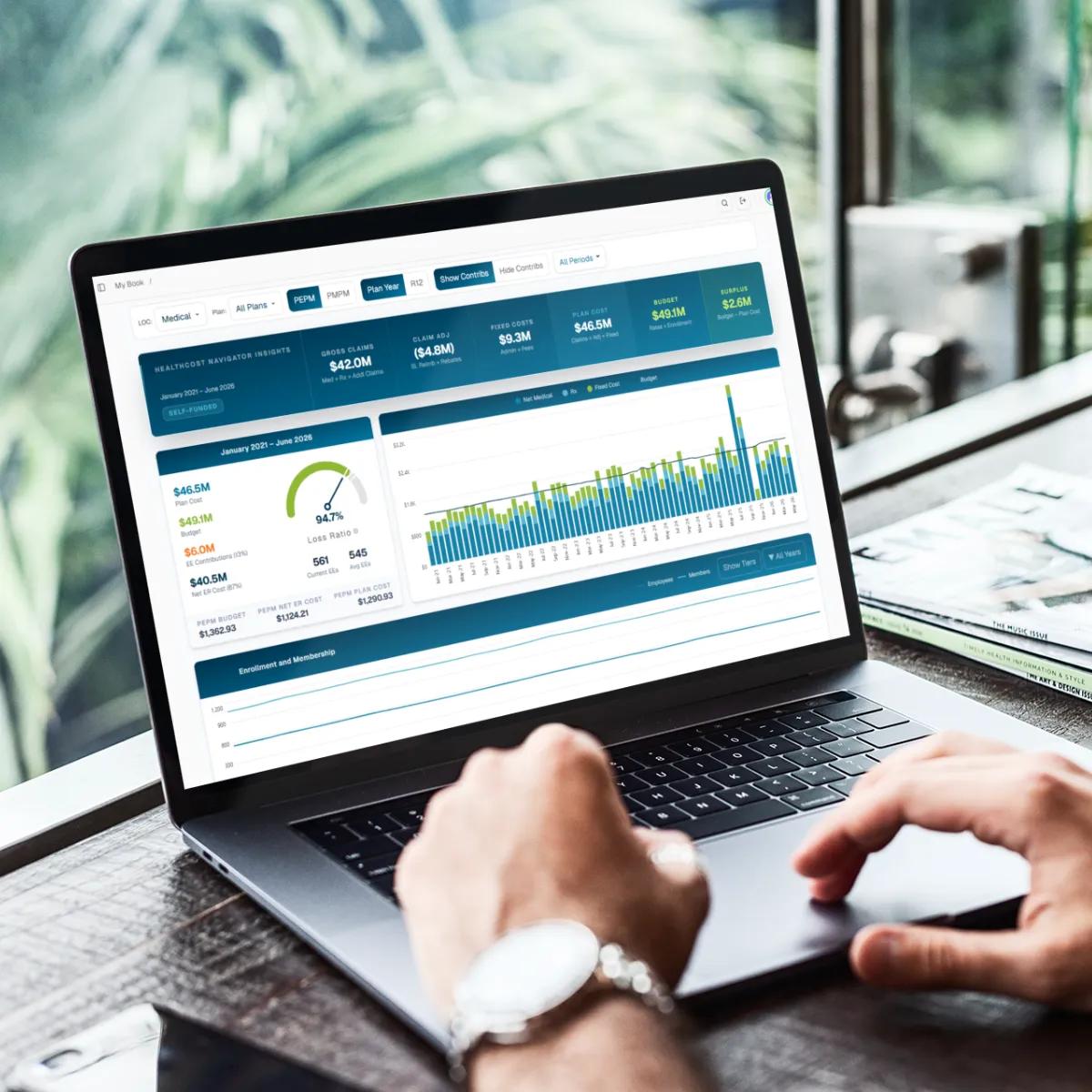
Employers often lack a complete view of their benefits ecosystem. Critical data lives across multiple sources—claims and utilization reports, benchmarking tools, forecasting models, and employee feedback—making it difficult to see what’s truly working and where gaps exist. Impact Studio brings spending, utilization, benchmarking, and employee value data into one panoramic platform, giving employers clear visibility into workforce trends and informed decision-making.
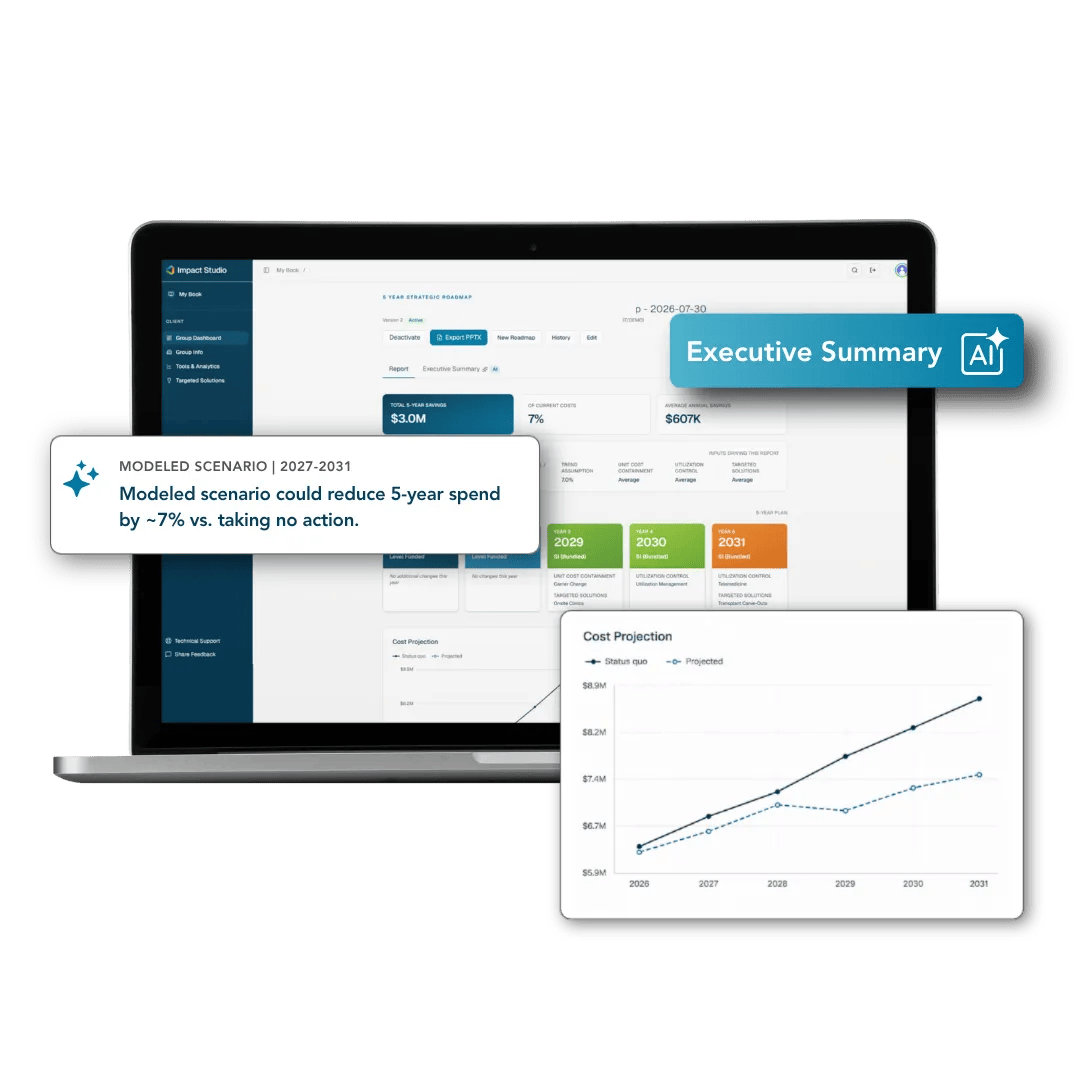
Following several consecutive years of significant healthcare cost increases, many employers are stuck in a reactive cycle—focused on managing the next renewal instead of planning with confidence. Without the ability to model future scenarios or understand the long-term impact of plan changes, cost containment becomes guesswork. Utilizing AI and sophisticated modeling tools, Impact Studio delivers actionable insights that help employers control costs, evaluate plan design changes, and build a 5-year total rewards roadmap aligned to business goals.
When benefits aren’t aligned with what employees actually value, employers risk investing heavily in programs that go underutilized and fail to drive engagement. Without a clear link between benefits spend and employee needs, even well-intentioned strategies can fall short. Impact Studio integrates employee value survey data directly into benefits strategy, helping employers design rewards programs that deliver measurable impact while managing costs efficiently.
AI INSIGHTS LAYER
Intelligence, Surfaced Automatically
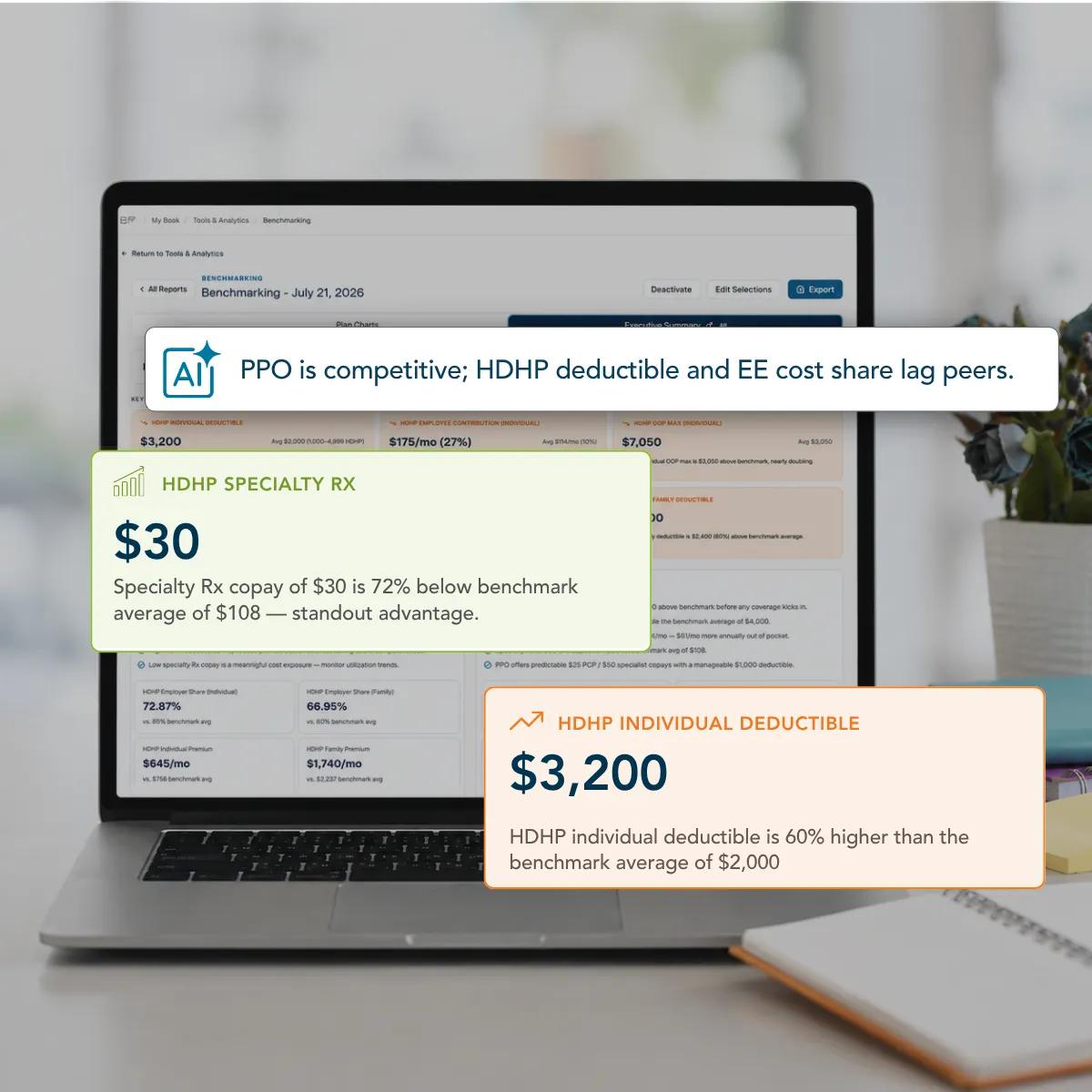
Impact Studio doesn't wait to be asked. It continuously analyzes your benefits data — utilization, benchmarks, trends — and surfaces the insights that matter most, before a report is ever run. Your consultant walks in with priority recommendations already on the table, ready to validate and model for you.
OneDigital’s Impact Studio Features
5-YEAR STRATEGIC ROADMAP
Plan Five Years Ahead, Starting Today
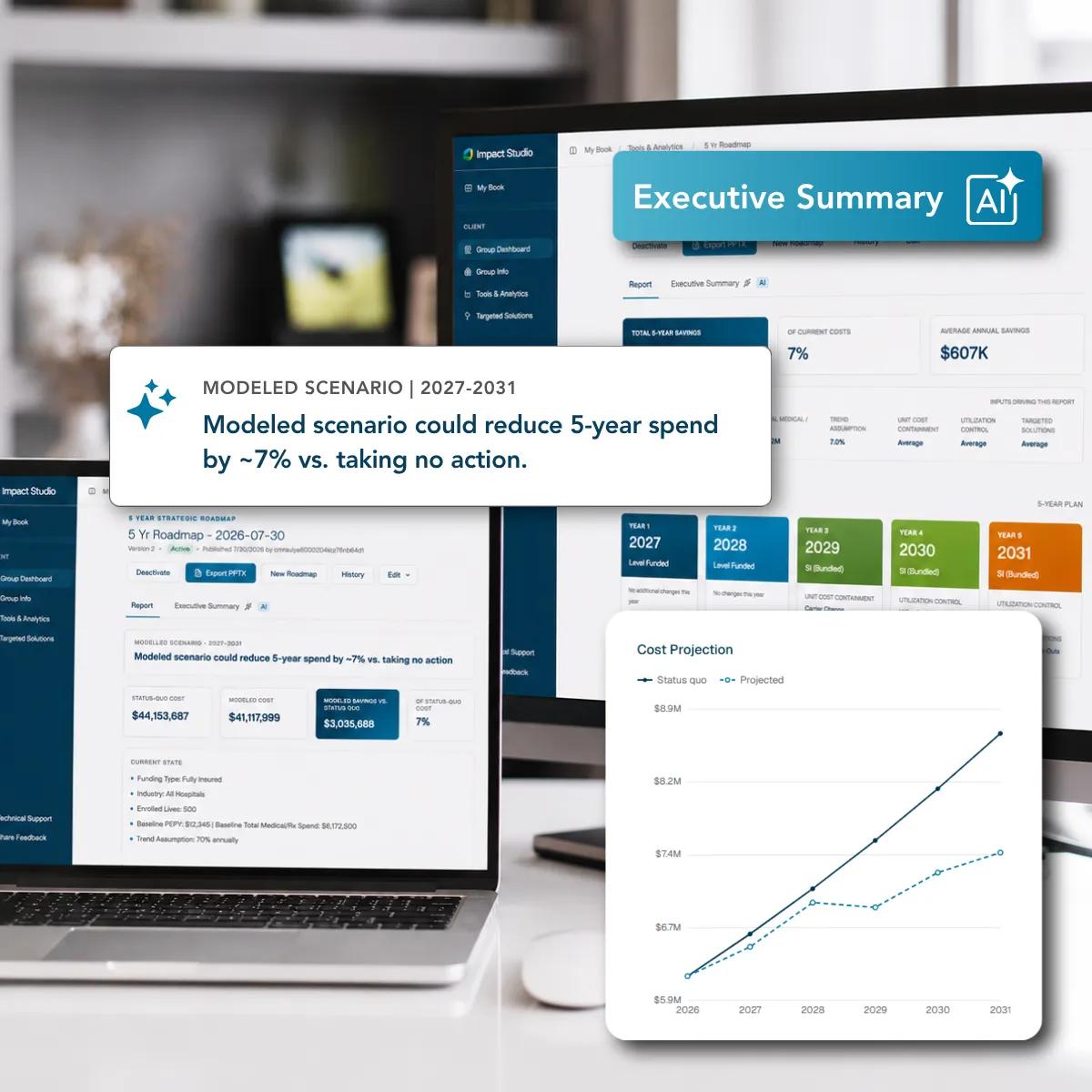
Model the full financial picture of your workforce strategy — benefits, retirement, and compensation — in one connected view, and see how today's decisions play out over the next five years.
Key Benefits:
- Forecast and compare cost strategies using actuarial modeling, research, and industry benchmarks
- Customize cost levers, funding arrangements, and targeted solutions across benefits, retirement, and compensation
- Weigh the potential risks and trade-offs of each strategy to ensure your organization is well prepared before you commit
- Turn complex modeling into presentation-ready charts your leadership team will actually use
Schedule A Personalized Demo
Impact Studio: Frequently Asked Questions
How Impact Studio turns fragmented benefits data into a connected, actionable strategy.
Most benefits brokers have tools — benchmarking data, utilization reports, claims analytics, employee surveys. The problem isn't a shortage of information. It's that those tools almost never talk to each other. Employers end up with a claims report from their carrier, a benchmarking deck from their broker, and an employee survey from somewhere else — and no one has time to reconcile them into a coherent strategy.
Impact Studio is OneDigital's answer to that fragmentation. It's a platform built specifically for OneDigital consultants to use with clients that layers benchmarking, claims and utilization data, cost modeling, and employee surveying data on top of each other — in one place. The combination is what makes it different. It's not just that the data exists; it's that you can see how it all connects and use that connection to make decisions that hold up financially and actually matter to employees.
It also saves OneDigital consultants significant time through built-in tools like an automated Storyboard presentation builder — which automatically pulls data, insights, strategies, and visualizations into clean, ready-to-present formats. That time savings means consultants spend less time assembling analysis and more time doing what actually moves the needle: identifying cost-saving opportunities and solving real client challenges.
It helps employers answer three questions that most benefits systems aren't built to answer clearly:
- Where is my money actually going? Benefits spend is rarely as transparent as employers assume. Impact Studio breaks down what a company is spending across health and benefits, retirement, wages, and salaries — and layers in utilization data to show what's actually being used. That means you can see things like: which benefits have high enrollment but low utilization, which populations are driving claims, whether employees are using high-cost care settings when lower-cost alternatives exist, which voluntary benefits are going largely untouched, and where spending is concentrated in ways that may not reflect employee needs. Most employers discover at least one area where they're spending meaningfully on something their workforce isn't engaging with.
- Is that spend working? Underutilization isn't just a communication problem — it's often a signal that the benefit itself isn't the right fit for the workforce. Impact Studio uses demographic benchmarking and industry comparisons to surface whether a benefit is misaligned — and when it is, the platform recommends alternatives based on how comparable employers structure their benefits for similar employee populations. If your workforce skews younger and healthier, but you're overinvesting in high-cost medical plan features, the data will show that — and suggest where redirecting those dollars could have more impact.
- What should I do differently? This is where most systems fall short. Employers know healthcare costs are rising — they've been rising for years — but the traditional response is to negotiate a renewal, make a small plan change, and hope for the best. That's partly because the tools most organizations use aren't built to model the full picture. Employees experience their benefits, retirement, wages, and time off as a complete package; most benefits platforms are not set up that way. Impact Studio is. Employers can model changes across their entire total rewards structure and see the projected financial impact in real time — before committing to anything. Want to see what switching from a fully insured to a self-funded model would do to costs over five years? Or how adding a captive arrangement compares? Or what a plan design change to deductibles would mean for both employer cost and employee disruption? Impact Studio runs those scenarios dynamically, so decisions are based on actual projections rather than gut instinct.
Impact Studio is accessed exclusively by OneDigital consultants on behalf of their clients. It's the analytical platform behind the strategic consulting OneDigital brings to its clients nationwide.
If you're interested in seeing what Impact Studio looks like for your organization, that's absolutely possible through a live demo. The more data an employer can bring to that conversation — claims history, current plan design, workforce demographics — the richer the output and the more specific the insights.
As part of the platform, OneDigital consultants use a built-in Storyboard feature — an automated presentation builder that extracts data, strategies, visualizations, and recommendations and organizes them into clear, easy-to-follow formats. This is especially useful for getting HR and finance leaders looking at the same picture at the same time, which is often one of the harder parts of building alignment around a benefits strategy change.
- 5-Year Strategic Roadmap — Models how different plan design and funding strategy changes would affect costs over time. This is particularly valuable for getting CFOs and finance leadership aligned on a multi-year strategy rather than reacting to each renewal in isolation. The roadmap can model transitions across the full funding spectrum — from fully insured plans, where employers pay fixed premiums and have limited claims visibility, to level-funded arrangements that offer a middle ground with potential surplus returns, to self-funded models that give employers direct access to their claims data and real control over costs, to group captive arrangements where multiple like-minded employers pool risk and share plan savings. For mid-market employers that have historically stayed fully insured, seeing the five-year cost differential between those options, with their actual data, often changes the conversation entirely.
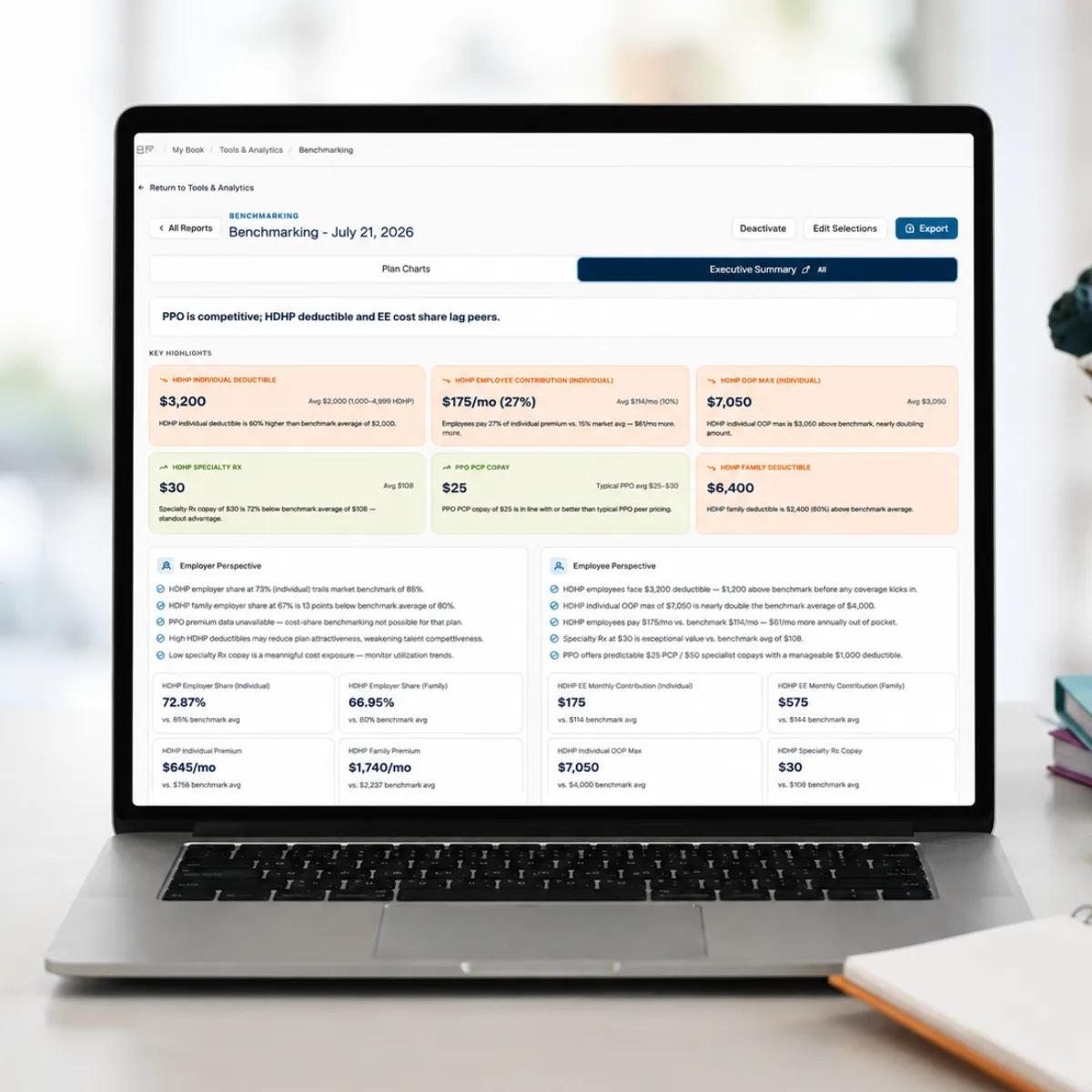
- Medical Benchmarking and Analytics — Shows how a client's plan compares to peers in their industry and region, including plan design, spend levels, and utilization patterns.
- Retirement Fee Benchmarking — As a plan fiduciary, employers have a legal obligation under ERISA to ensure that their retirement plan fees are "reasonable." High fees erode participant account balances quietly over time. Impact Studio helps employers benchmark their retirement plan fees against peers, fulfilling a core fiduciary duty and identifying where fees can be negotiated down. The Department of Labor recommends reviewing plan fees at least every three to five years — and Impact Studio makes that review a standard part of the annual consulting conversation rather than a one-off project.
- Integrated Employee Value Data — Pulls in insights from OneDigital's Employee Value Perception Study to show whether benefits are valued by employees, not just whether they're being used. Alternatively, if you have your own surveying results, they can be uploaded directly into the platform to map back to your specific workforce.
- Medicare Savings Analysis — Analyzes cost savings opportunities for employers with Medicare-eligible employees.
- Demographic Benchmarking — Compares workforce composition to industry norms, which informs where plan design may be misaligned with actual employee population.
& more! Impact Studio releases new features on a monthly basis. Check back frequently for updates on what’s new.
Every employer's opportunity looks different, but the pattern is consistent: Impact Studio makes savings visible and quantifiable in places most employers haven't had access to before, and it removes the barriers that usually keep that opportunity from turning into action.
Consultants using Impact Studio report a 25% reduction in time spent on workforce planning — and that time gets redirected directly toward finding and building the case for cost-saving strategies that actually get implemented. That's not a trivial shift. A lot of cost-saving work in benefits stalls not because the strategy is wrong, but because the consultant doesn't have time to run the analysis, or the output isn't in a format that gets leadership buy-in.
Impact Studio changes both of those dynamics. On the savings side, opportunities typically show up in a few consistent places: funding strategy, where many employers are overpaying because they're fully insured without knowing what a self-funded or captive arrangement would look like for their specific claims history; underutilized programs, where benefits employees don't engage with are a direct cost with no return; and retirement fees, one of the most consistently overlooked cost levers.
The AI in Impact Studio is doing the analytical work that would otherwise take a consultant hours to complete manually — and doing it continuously, not just at renewal time.
The core capabilities include: claim-level cost analysis, which identifies specifically what's driving a cost trend and suggests targeted interventions with projected impact; real-time scenario modeling, which projects the financial impact of a plan change dynamically rather than requiring a separate actuarial engagement; demographic-driven recommendations, which cross-reference workforce demographics with industry benchmarking to surface likely-fit benefit alternatives; predictive cost trajectories, which provide five-year projections across multiple scenarios using actuarial research and real market data; and connected cross-portfolio intelligence, which ensures a recommendation in one area doesn't inadvertently create a blind spot in another.
AI-generated summaries run throughout the platform as well, translating dense data into clear, plain-language takeaways that call out where the impact is and where the opportunity is — so a consultant doesn't have to dig through raw data to find the story it's telling.
The intent is straightforward: the AI handles the analysis so OneDigital consultants can focus on strategy and judgment — the parts that actually require human expertise.
Most employers make benefits decisions based on enrollment numbers and claims data. Those metrics tell you what employees are using — but not why, and not what they actually want. The gap between those two things is where a lot of benefits spend gets wasted.
Impact Studio integrates data from OneDigital's Employee Value Perception Study, a proprietary research panel of over 5,000 U.S. employees surveyed across genuine life stages — not just age brackets. The study segments employees by how they actually live: single parents, dual-income households with children, dual-income households without children, single employees under 45, single employees over 45, and career levels ranging from entry-level to executive.
When this data sits alongside claims and utilization data inside Impact Studio, a consultant can show a client not just what they're spending, but whether employees actually value it — and make a specific, data-backed case for where to reallocate investment. That's the difference between a benefits strategy that looks good on paper and one that actually earns engagement and retention.
Most tools in this space are built to do one thing well — benchmark a plan, flag utilization patterns, or model a cost-savings scenario — and employers end up piecing together results from several disconnected sources to get the full picture. Impact Studio is built around a different idea: that those data points are only as useful as the connections between them.
By layering benchmarking, claims and utilization data, cost modeling, and employee perception data into a single platform, Impact Studio surfaces insights that don't show up when those tools are used in isolation. A benchmarking result means something different once it's read alongside actual utilization and how employees say they value that benefit. A cost-savings scenario is more useful when it's modeled against five years of projected impact, not just the next renewal. That connective intelligence is what allows a recommendation in one area — say, plan design — to account for its effect on retirement or total rewards, rather than solving one problem while creating a blind spot somewhere else.