Leadership Interview
Early Adopters: Leading AI from the Inside Out
An Interview with OneDigital Chief People Officer, Elizabeth Chrane & OneDigital HR Consulting Practice Leader, Meagan Karry
Author
Article Summary
In a candid interview, Chief People Officer Elizabeth Chrane shares how OneDigital has evolved from early AI exploration into full-scale adoption across recruiting, benefits, and workforce strategy. The conversation offers a practical look at measurable efficiency gains, shifting talent expectations, and advice for HR leaders facing similar decisions as they decide how central AI should be to their operating priorities.
Two years ago, Elizabeth Chrane was doing what a lot of HR leaders were doing: saving articles in a folder she never had time to read. AI was everywhere in the headlines, and she knew it mattered — she just didn't know where to start.
Today, Elizabeth leads one of the more mature internal AI adoption stories in HR. OneDigital's People & Culture function has moved from an informal learning task force to a wholesale reimagining of how the organization recruits, onboards, manages benefits, and develops its workforce. The budget impact has been real. The talent strategy has shifted. And the urgency, she'll tell you, has only intensified.
I sat down with Elizabeth to walk through the journey — what worked, what she'd do differently, and what she thinks every HR and business leader needs to hear right now.
Meagan Karry: Let's start at the beginning. When did you first take AI seriously?
Elizabeth Chrane: About two years ago, I was getting bombarded with articles. AI is coming, this is going to change work, here are high-level HR use cases. I kept putting them in a folder, telling myself I'd go back and read everything. I never did. I became overwhelmed.
So I did something simple. At my next team meeting, I asked if anyone wanted to join a task force — not leaders, their people, the ones actually doing the work. Twelve people volunteered from across all eight teams in People and Culture. We started meeting every other week. Each session, two or three people would share what they'd been reading.
Meagan Karry: What was the mood in those early meetings?
Elizabeth Chrane: Scared, mostly. Compliance and Learning & Development came in focused almost entirely on the risks — privacy concerns, state laws around AI usage in recruiting, potential bias. I was actually glad Compliance joined early, because those are real questions you need to be asking. But over the first couple of months, something shifted. The team came back with fifteen different use cases from within People and Culture alone. They were thinking beyond email cleanup. Recruiting, content creation, benefits navigation — the ideas got substantive quickly.
Meagan Karry: What were the biggest early opportunities you identified?
Elizabeth Chrane: Two areas stood out. The first was recruiting. We had 150 open job requisitions at any given time and were receiving somewhere between 1,000 and 1,500 applicants per role. Eight people on the recruiting team. The math doesn't work without help. And when we actually did the math on just one piece of it — interview scheduling — we were spending $120,000 a year in salary expense just to coordinate calendars. That's not recruiting. That's administration.
The second was benefits. We were growing by 500 to 600 people a year, and our benefits team was managing all of that growth on top of their existing workload. I had always budgeted for two to three new hires on that team each year to keep pace. For calendar year 2025, I didn't budget for anyone. That was the moment the board leaned in. When AI stops being about making work easier and starts affecting headcount planning, people pay attention.
Meagan Karry: And do you have a sense of the actual volume your benefits team was absorbing?
Elizabeth Chrane: Yeah, and this is where it gets real. In the first six months after we implemented Avante, the platform resolved 4,275 employee inquiries instantly — without the team touching them. And saved 565 hours. That's basically three months of someone's work, given back. So when I told the board I wasn't adding headcount, it wasn't a gut feeling. The numbers were right there.
Meagan Karry: Tell me about the Avante partnership — that seems like a turning point.
Elizabeth Chrane: I'd been approached by outside companies offering benefits bots — systems where you give it answers and it answers employee questions. That felt limited. What I realized I actually wanted was insight. A system that was learning from the questions it was fielding so we could act on that information upstream.
When OneDigital formed a partnership with Avante, that's what we got. The platform started surfacing patterns in what employees were asking. If we saw a spike in questions about financial services or compensation, our communications team could get ahead of it with education before it became noise. That was a genuine operational win.
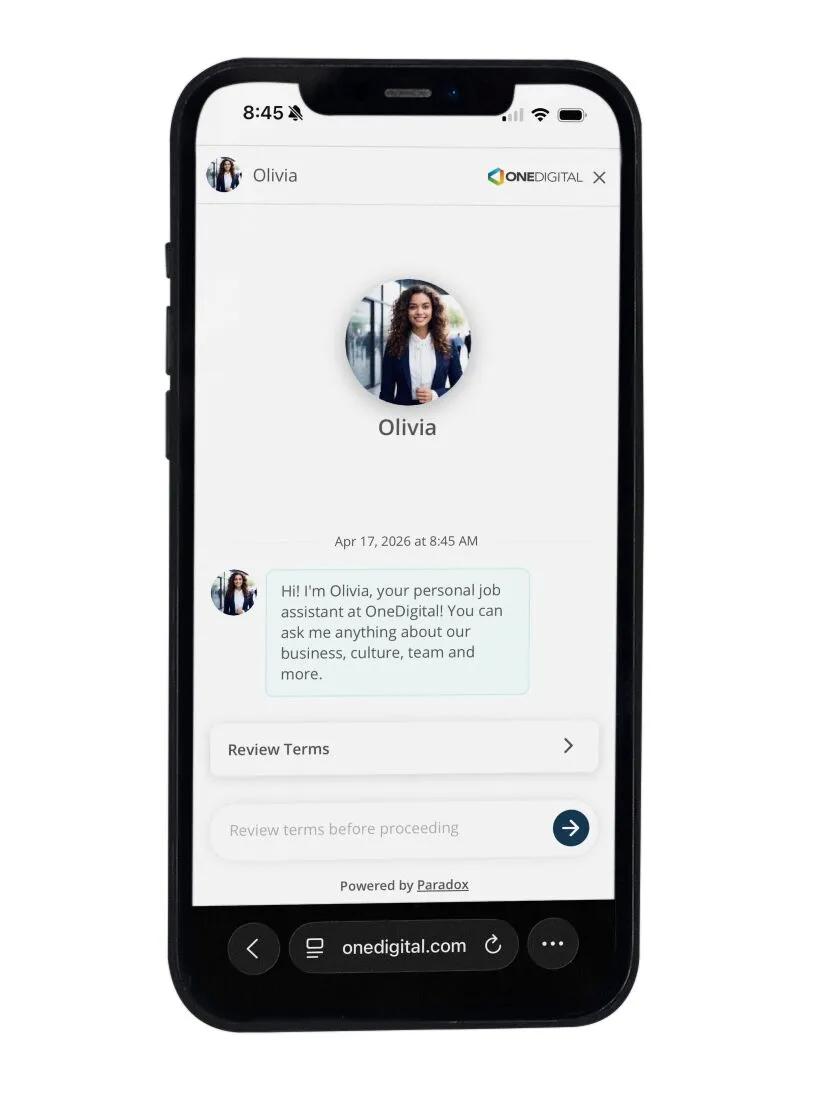
Elizabeth Chrane (continued):And on the recruiting side, we saw something similar with Olivia — that's our AI assistant in the hiring process. Scheduling interviews used to take about 300 minutes per requisition. With Olivia handling it, we're down to about two. That's a 99% reduction in effort for something that had nothing to do with actually finding the right person for the job.
We're now in the process of feeding the platform our claims data, which will let us ask much more sophisticated questions — things like, "What are the cost drivers in our current plan, and what would you recommend to address them?" That's the next level. You need the data architecture in place first, but the capability is real.
Meagan Karry: For smaller employers who may not have the scale OneDigital has — is any of this accessible to them?
Elizabeth Chrane: Absolutely, and I think the misconception that AI requires major infrastructure investment is one of the things holding mid-sized businesses back. Most companies don't need to go shopping for AI. If you're using Microsoft, Salesforce, Workday, UKG, ADP — those platforms are already building AI into their systems. Go to your existing vendors first. Ask what they have. You might be surprised how much capability is already sitting inside tools you're already paying for.
The adoption journey looks the same regardless of company size. It starts with fear. Then there's an exploratory phase — getting people to actually open a tool and try something. Once they see it do something Google can't, curiosity takes over. After that, the hard work is focusing that energy on what actually matters for the business, not just what's interesting.
"For organizations that haven't started yet — I would have told you 18 months ago this was a three-to-five year evolution. I've shortened that estimate to one year. That shift should feel urgent."
Meagan Karry: How has this changed the way you think about hiring?

Elizabeth Chrane: Significantly. We used to weight years of experience heavily. Domain expertise, tenure, that kind of thing. We still value that — but we've shifted what we're screening for. We now put every candidate through a cognitive assessment. It's not about measuring intelligence. It's about understanding how someone learns. Are they curious? Are they adaptable? Can they pick up new ways of doing things?
We've also made AI literacy a standard part of the screening conversation. We ask candidates what they know about AI, how they've used it, how they think about it. These are data points, not disqualifiers, but they factor into the full picture we present to hiring managers.
The underlying logic is straightforward. A candidate can have a strong book of business and years of experience, but if they're not willing to adopt new ways of working, that's a problem. We're investing heavily in new technology, and we need people who will use it.
Meagan Karry: You mentioned that your thinking has shifted in the past few weeks. What's changing?
Elizabeth Chrane: For a long time, I was comfortable with the message that AI would superpower our people without displacing them. I believed it. But my view has evolved. The pace of change has accelerated past what any of us predicted.
What I see now is that adoption isn't optional. If someone at OneDigital isn't willing to work with AI, this probably isn't the right place for them. That's a harder thing to say than it was a year ago. And for organizations that haven't started yet — I would have told you 18 months ago this was a three-to-five year evolution. I've shortened that estimate to one year. That shift should feel urgent.
Meagan Karry: What do you wish you'd done differently?
Elizabeth Chrane: Two things. First, I worked a little too much in a bubble early on. The task force was valuable, but I wasn't talking to other leaders across the organization about what they were doing. By the time we compared notes, we were all at different stages and moving in different directions. Cross-functional alignment from the beginning would have saved a lot of rework.
Second, I leaned on the task force too much as a substitute for my own learning. They did great work — but it meant I was playing catch-up on things my own team already understood. My advice: get in yourself, early. Don't just delegate the learning.
Meagan Karry: Any final advice for HR leaders just starting out?
Elizabeth Chrane: Prioritize Learning & Development, change management, and communications before you think you need to. The instinct is to start with efficiency gains — and that's a reasonable place to start. But the organizations that struggle are the ones where L&D and communications are still figuring out the basics while the rest of the business is trying to move. Those teams set the tone for everyone else. If they're behind, the whole organization is behind.
On governance: IT and Legal should own the broader policy — what systems are approved, where data can live, what gets locked down. HR's job is to stay hyper-vigilant about the specific data in their own systems and understand the state laws that apply to AI usage in recruiting. And if you don't have an AI policy in your handbook yet, that's the place to start. We're still finalizing ours. It's foundational work, and the earlier you do it, the better.
Meagan Karry: Any closing thoughts?
Elizabeth Chrane: What excites me is how much this opens up for employers of all sizes. Small HR teams that couldn't dream of building certain capabilities now can. That's genuinely new. The floor for what's possible has risen, and organizations that lean into that — rather than waiting for it to come to them — are the ones that will define what the next era of HR looks like.
Take the driver's seat of your organization's AI journey. Explore our AI + HR Hub for Employers for tools, resources, and expert guidance to help you lead this transformation.