Markets in Focus: An Expansion Under Pressure
Author
Article Summary
Growth persists into Q4 2026, but inflation, higher borrowing costs, and lofty profit expectations raise the stakes. Explore key themes, risks, and actions to stay focused on long-term goals.
The economy is still growing, and company profits remain strong. But persistent inflation and higher borrowing costs are putting more pressure on households and businesses. As the year enters the 4th quarter, investors should review how their portfolios balance risk and return.
The U.S. economy enters the final quarter of 2026 with continued growth and strong company profits. However, higher interest rates may put that strength to the test. In September, the Federal Reserve raised its key interest rate by a quarter percentage point, bringing the target range to 3.75% to 4.00%.[1] The increase reflects the continued challenge coming from inflation and could put pressure on parts of the economy.
Earlier this year, we looked at how energy prices affect inflation and Fed policy. We also explored whether spending on artificial intelligence, or AI, could lead to lasting profits. We are now watching how households and businesses handle higher interest rates, and whether companies can meet investors' expectations.
We expect the economy to continue growing, but likely at a slower pace into early 2027. We also expect inflation to stay above the Fed's target and interest rates to remain high. The Fed could raise rates again, but those decisions will depend on future economic reports. For investors, this means reviewing what you own and relying on your long-term goals to guide any changes.
With that in mind, we see three themes shaping the Q3 market conversation, three risks worth monitoring, and three actions investors can take to stay focused.
Three Themes and The Risks to Watch
Higher Rates are Reaching Households and Businesses
Persistent high inflation has continued to impact the United States. The August release of the Core Personal Consumption Expenditures (PCE) price index showed that inflation rose 3.0% from a year earlier, still above the 2% target. Although energy prices are excluded from Core PCE, higher fuel costs have still pushed prices higher by making shipping and production more expensive. Businesses must weigh how much of those costs they can pass on to customers without losing sales.
The Federal Open Market Committee (FOMC) raised interest rates at their meeting in September in an attempt to bring inflation closer to target. Higher rates have a dampening effect on the economy by making borrowing more expensive, which can slow both household spending and business investment. As demand eases, businesses face less capacity to raise prices.
The effects are visible in housing and business financing. While The Fed does not set mortgage rates directly, its policy influences borrowing costs across the economy. The average 30-year fixed mortgage rate reached 7.28% in the week ending October 1.[3] That affects the housing market in two ways. First, it makes homeownership more expensive for those trying to buy a home, while at the same time discouraging current owners from moving because they would have to give up a lower mortgage rate. Businesses face a similar problem. If they need to borrow to expand their business or replace old equipment, the higher interest cost may cause them to delay or cancel those plans.
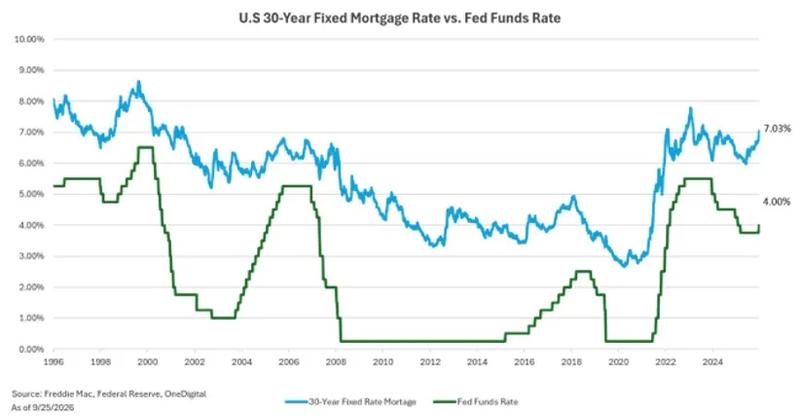
Some cooling of the economy is part of the Fed's effort to reduce inflation. The challenge is easing price pressures without slowing growth more than necessary.
Risk to watch: Inflation stays high as growth slows. Further disruptions to energy supplies, especially in the Middle East, could keep prices high and lead to more rate increases. That could put added pressure on spending and hiring, making it harder for companies to meet profit expectations. We still expect the economy to grow into 2027, but we will be watching inflation and the further effect of higher interest rates.
Economic Strength is Uneven
Consumer spending and business investment helped drive economic growth in the second quarter. Gross domestic product, or GDP, measures the goods and services the economy produces. After adjusting for inflation, GDP grew at a 2.2% annualized rate in the second quarter.[5] Jobs help support that growth by providing income that households can spend. But September's employment report showed modest job gains that were below expectations and the unemployment rate edged up to 4.2%.[6] While unemployment is only slightly above historic lows, there has been some slowing. Slower hiring can make it harder to find work or move to a better-paying job.
Slower hiring can also make it harder for households to keep up with rising prices and higher borrowing costs that we mentioned earlier. Rising prices tend to stretch budgets unless incomes keep pace, while higher rates make new loans and credit card balances more expensive. Together, these costs can leave families with less money for other purchases.
These pressures affect households differently. We have described this as a “K-Shaped” economy. Families with steady incomes and high savings rates have less need to borrow, allowing them more room to absorb higher costs. However, those families with tighter budgets may need to cut spending or take on more debt when prices rise. The rate at which borrowers fall behind on credit card bills has been rising, although delinquency rates across most other types of debt like automobiles and houses have been fairly stable.[7,8] These figures suggest that financial strain remains uneven.
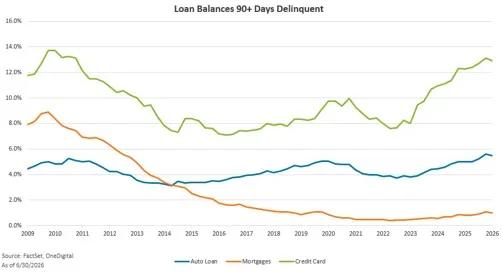
These differences also matter for companies. Businesses serving customers with stronger finances may hold up better than those relying on households that borrow for optional purchases. Businesses also face their own borrowing costs, which can leave less money for expansion.
Risk to watch: Pressure spreads to more households. A sharper weakening in the job market or a broader rise in missed debt payments could signal that more families are struggling. If more households cut spending, businesses may see slower sales and become more cautious about hiring and investing. We are watching whether these pressures spread beyond the families and businesses already under strain.
Company Profits Remain a Bright Spot, But Expectations Are High
Company profits continue to offer a reason for confidence. As of the beginning of October, analysts are expecting third-quarter profits at S&P 500 companies to rise 29.5% from a year earlier. They forecast gains across all eleven sectors.[9] These, of course, are estimates, and they set a high bar. We are watching whether these strong forecasts and expectations can be met.
It also matters how companies earn those profits. Some technology companies recently reported large gains on investments they own.[10] Those gains can raise reported profits, but investors are looking for evidence that the company's main business is doing better. We are looking closely at the composition of profits and, more importantly, that can be repeated and can generate cash for their business.
That question matters even more for AI spending. Spending on data centers and chips creates demand today. The payoff of those investments depends on how quickly customers begin using new services and how much profit those services earn. And because of the massive investment being made by hyperscalers, a lot of the announced plans to pay for more computing power include borrowing money and selling new shares.[11]
Borrowing also connects AI spending to bond investors. Corporate bonds are loans investors make to companies. These bonds usually offer higher yields than Treasury bonds. That extra income helps compensate investors for the risk that the company may not repay its debt. Today, there is a relatively small gap, or credit spread, between the yields offered by U.S. Treasuries versus corporate bonds. [12] If companies start reporting bad results, or even good results that fall short of expectations, it could lead to negative performance for corporate bonds.
Risk to watch: Profits fall short of expectations. A company can report strong profits and still disappoint investors if its results or outlook fall short of what they expected. For AI projects, things like delays, limits on available power or weaker demand could push back the payoff. Companies that borrow heavily still owe interest while waiting for revenue, leaving less room to handle those delays. Financial trouble at a major borrower could hurt both its stock and its bonds.
What Could Go Better
There are still plenty of reasons to remain optimistic.
Inflation could ease faster than expected if energy costs fall and supplies improve. If jobs and company profits hold up, the Fed may have more room to pause their rate increases. That could ease some pressure on borrowing costs, helping housing and smaller businesses. Falling market interest rates could also lift the prices of existing fixed-rate bonds.[4]
Stronger demand for AI services and more cash earned from those investments would help ease concerns about paying for new projects. We are watching for improvements that support growth while bringing inflation down. Rates falling because inflation is easing would be a more encouraging sign than rates falling because the economy is slowing sharply.
The Midterms and Investment Decisions
November's midterm elections will bring more headlines. The results could affect tax, trade and spending policies, along with rules for certain industries. Predicting market returns from an election result is much harder. The details of each policy, how it is carried out and the state of the economy matter more than a party label alone. We favor changing plans when specific policy changes affect your finances, while keeping portfolios ready for a range of political outcomes.
Actions for Investors
Check that your portfolio’s risk fits your plan
Your financial plan should reflect your goals, when you expect to need your money, and how much investment loss you are willing and able to accept. Review whether those factors have changed, then compare the risk across your accounts with the risk your plan calls for. Market moves can change that balance even if you haven’t traded. Taking more risk than intended could expose you to losses that disrupt your plan. Taking too little may limit the growth your plan relies on. Your advisor can help assess whether your current holdings still fit your needs.
Rebalance or Reposition When Needed
We expect the economy to keep growing, while higher costs put more pressure on households and businesses. For investors, the next step is to review what your portfolio needs to deliver and how much risk you are taking. Consider whether some your allocation to stocks and bonds have shifted enough to warrant a rebalance. Your OneDigital advisor can help you connect those choices to your spending needs, how long you plan to invest and how much risk you can accept.
Want to learn more about current happenings in the retirement space? Check out this webinar, “Fiduciary Academy: Q4 Litigation, Legislation & Retirement Trends”
Investment advice offered through OneDigital Investment Advisors LLC. The materials and the information provided are not designed or intended to be applicable to any person's individual circumstances. These statements do not constitute an offer or solicitation in any jurisdiction. Any reference to a specific company is not a recommendation to buy, sell, or hold any security. Any economic forecasts in this commentary are merely opinion, and any referenced performance data is historical. Past performance is no guarantee of future results. All investment involved risk of loss. Some information has been obtained by sources we believe to be reliable. OneDigital Investment Advisors LLC makes no representations as to the accuracy or validity of this information. Additionally, OneDigital Investment Advisors does not have any obligation to provide revised investment commentary in the event of changed circumstances. Views and Opinions expressed herein are provided as of October 8, 2026. Market Data provided by FactSet as of 9/30/2026. ID: 00816759
Sources
Data and published estimates available as of October 5, 2026. Economic figures may be revised. The outlook and portfolio observations reflect OneDigital team input; analyst earnings estimates are identified separately in the text.
[1] Federal Reserve. FOMC statement. September 16, 2026.
[2] U.S. Bureau of Economic Analysis. Personal Income and Outlays August 2026. September 30, 2026.
[3] Freddie Mac. Primary Mortgage Market Survey. October 1, 2026.
[4] U.S. Securities and Exchange Commission. Investor Bulletin on interest rate risk in fixed-rate bonds. June 26, 2013.
[5] U.S. Bureau of Economic Analysis. GDP Third Estimate Second Quarter 2026. September 30, 2026.
[6] U.S. Bureau of Labor Statistics. The Employment Situation September 2026. October 2, 2026.
[7] Federal Reserve Bank of New York. Household Debt and Credit Second Quarter 2026 release. August 11, 2026.
[8] Federal Reserve Bank of New York. How Distressed Are Consumers? Reconciling Diverging Credit Card Delinquency Measures. August 11, 2026.
[9] FactSet. S&P 500 Earnings Season Preview: Q3 2026. October 2, 2026.
[10] FactSet. Mag 7 Companies Reported Earnings Growth Above 100% Boosted by Investment Gains. August 28, 2026.
[11] Oracle. Equity and Debt Financing Plan for Calendar Year 2026. February 1, 2026.
[12] ICE Data Indices via FRED. ICE BofA US Corporate Index Option Adjusted Spread. Observation for October 1, 2026.