Markets in Focus: Resilience With Less Room for Error
Author
Article Summary
Growth persists into Q3 2026, but inflation, energy volatility, and elevated AI expectations raise the stakes. Learn key themes, risks, and actions to stay focused and disciplined.
Economic growth and continued business investment, especially in AI and related infrastructure, are still providing support in the U.S. But inflation, energy uncertainty, and high expectations for AI-related companies leave markets with less room for disappointment.
We enter the third quarter with an economy that has remained more resilient than many investors expected, but with a market backdrop that is becoming less forgiving. Economic growth has continued, consumer spending remains positive overall, and companies are still investing heavily in technology and infrastructure. At the same time, inflation has moved higher, energy markets remain uncertain, and hiring has slowed.
Several of the issues we highlighted earlier this year remain central to the Q3 outlook. In Q1, we focused on the potential for market leadership to broaden, the shift from AI excitement to measurable business results, and the effect of policy uncertainty on markets. In Q2, geopolitical developments became a more immediate market driver, while inflation, energy prices, and Federal Reserve policy became increasingly connected.
Those risks have not disappeared. Instead, they have become more closely linked. Energy developments have affected inflation. Higher inflation can limit the Federal Reserve’s ability to lower interest rates. And high expectations for a relatively narrow group of companies can make markets more sensitive when earnings or investment results disappoint.
As we look to the rest of the year, we expect the economy to continue expanding, though conditions may vary across industries, companies, and households. Consumer spending, business investment, and corporate earnings should continue to provide support, but each faces a more mixed backdrop. Ongoing uncertainty around inflation, energy markets, and interest rates could make the months ahead more uneven and keep markets sensitive to disappointing news.
That can make it feel as though every headline requires a portfolio response. We do not think that is the right takeaway. A more useful response is to stay diversified, avoid emotional decisions, and make sure portfolios remain aligned with long-term goals, time horizons, liquidity needs, and risk tolerance.
With that in mind, we see three themes shaping the Q3 market conversation, three risks worth monitoring, and three actions investors can take to stay focused.
Three Themes Shaping Q3
1) The economy is still growing, but conditions are becoming more uneven
The U.S. economy continues to expand. Real Gross Domestic Product (GDP) increased at a 2.1% annualized rate during the first quarter of 2026, supported by investment, exports, government spending, and consumer spending. ¹ Real consumer spending saw continued growth of 0.3% in May. ²
The labor market remains relatively stable, but hiring has slowed over the past several months. Nonfarm payrolls increased by 178,000 in March,3 148,000 in April, 129,000 in May, and 57,000 in June.4 As a result, the three-month average pace of job growth fell to 111,000 in June, down from 164,000 one month earlier.4
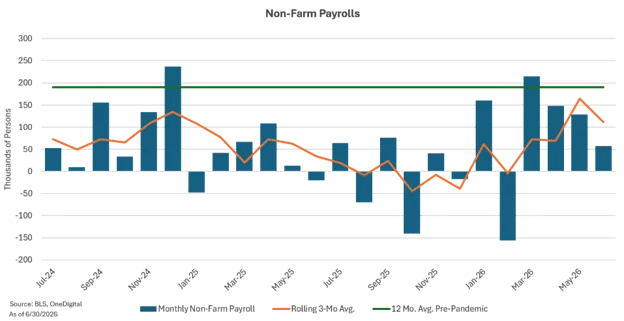
The unemployment rate edged down to 4.2% in June, but the employment picture was uneven across industries. Job gains continued in professional and business services, social assistance, and health care, while leisure and hospitality lost jobs and most other major sectors showed little change.4
These figures do not point to a broad economic downturn. But, they do suggest that labor demand is becoming more selective, reinforcing the broader theme that conditions are varying more widely across industries, companies, and households.
Consumer spending is still growing overall, but the experience is not uniform. The consumer backdrop is increasingly K-shaped. Higher-income households have generally remained more resilient and better able to absorb higher prices, while lower-income households are showing greater financial strain and may be more likely to limit discretionary spending.5
Hiring has slowed, some consumer-facing businesses are showing more sensitivity to higher prices, and households remain exposed to elevated borrowing costs, energy expenses, and everyday costs of living. These factors suggest that the economy and markets may face a less smooth path from here, with interest rates potentially staying higher for longer, corporate earnings becoming more uneven, and investors less willing to overlook disappointing results.
What this means for investors: Economic resilience remains positive, but broad market indexes may not tell the full story. Company fundamentals, pricing power, balance-sheet strength, and earnings delivery may matter more as growth becomes less uniform
2) Inflation, energy, and the Federal Reserve remain tightly connected
Inflation is again one of the most important market issues. In May, the Consumer Price Index increased 4.2% from a year earlier.6 The Personal Consumption Expenditures (PCE) price index increased 4.1% year over year. ² The Federal Reserve’s preferred measure of underlying inflation, Core PCE, which excludes food and energy, increased 3.4%. ² The Federal Reserve’s 2% longer-run inflation objective is defined in terms of the PCE price index, and both PCE measures remain above that goal. ⁷
Energy has been an important contributor to recent inflation pressure. The CPI energy index increased 23.5% over the year through May.6 Higher energy costs affect more than gasoline bills. They can also raise transportation costs, put pressure on business margins, weigh on household budgets, and influence inflation expectations.
At its June meeting, the Federal Reserve held its target range for the federal funds rate steady at 3.50% to 3.75%. The Federal Reserve noted that economic activity was expanding at a solid pace and that inflation remained elevated relative to its 2% goal. 8 The market interpreted this to mean that the likelihood of an interest rate cut this year is becoming increasingly low. As of July 7th, federal funds futures reflected a greater probability of rate increases later in the year than rate cuts, although those expectations can change quickly. ⁹
The key question is not whether oil prices move higher or lower over a few weeks. It is whether supply disruptions or elevated energy costs become broad enough and persistent enough to affect the wider inflation outlook. The Energy Information Administration’s latest outlook assumes that oil supply and trade flows continue to normalize, and inventories are rebuilt over the second half of the year. A slower recovery or renewed disruption could keep energy prices a source of inflation pressure.¹⁰
What this means for investors: Inflation matters because it affects everyone, from the overall cost of living for consumers to the cost that companies pay for inputs. This, in turn, impacts interest rates, bond yields, equity valuations, and overall investor sentiment. Inflation has been elevated since the tail-end of the COVID-19 pandemic, and the recent spike in energy prices continues to keep it top-of-mind.
3) AI investment remains important, but the bar is getting higher
Artificial intelligence remains one of the most important long-term themes in the market. In Q1, the conversation began shifting from excitement about AI toward the potential for measurable productivity gains and returns on investment. In Q2, the focus became more selective: which companies could translate heavy spending into durable earnings growth?
That question remains central in Q3. Large technology companies continue to invest heavily in data centers, cloud capacity, semiconductors, networking equipment, and power infrastructure. Alphabet recently raised its expected 2026 capital spending range to $180 billion to $190 billion.11 Meta expects 2026 capital spending of $125 billion to $145 billion.12
These investments are helping support activity across a wide swath of the economy, However, investors are increasingly focused on whether the spending will ultimately produce durable revenue growth, higher productivity, and attractive returns on capital.
The recent SpaceX IPO has also renewed investor attention on large, high-growth companies entering the public markets. The company’s offering included 555.6 million shares at $135 per share, representing $75 billion before the underwriters’ overallotment option.13 If additional high-profile companies come to market later this year, they could further increase investor interest in growth-oriented companies and market concentration.
New listings can create opportunity, but they can also create pressure to chase early performance or build too much exposure to a single company or theme.
What this means for investors: Many investors already have meaningful exposure to AI-related companies through broad market indexes and diversified portfolios. The key is to understand how much exposure is already embedded in a portfolio and avoid adding so much to a single company, industry, or narrow segment that the portfolio becomes overly dependent on one long-term theme.
Want to learn more? Read our recent OneDigital article on the SpaceX IPO and the potential implications for index exposure: "SpaceX and the Index Effect: What Investors Should Know."
Three Risks Worth Watching
The risks we are watching in Q3 will be familiar to readers of our earlier 2026 outlooks. Inflation, geopolitical disruptions, and concentrated market leadership have remained important throughout the year. The difference today is that they are increasingly connected.
1) A renewed energy shock and higher chip prices could boost inflation
The most immediate macroeconomic risk is that a prolonged disruption to global energy supplies causes oil, electronics, and related prices to move higher again. The potential impact would extend beyond gasoline prices.
Oil is a critical economic input for a variety of industries and can affect the prices for a wide range of goods and services. Additionally, as many consumer goods and appliances have become more computerized, semiconductors have become a larger share of their cost. Higher oil and semiconductor prices can contribute to higher costs for gas, travel, food, fertilizer, consumer electronics, cars, and a variety of other goods.
A more persistent energy shock combined with higher chip prices could leave the Federal Reserve with an uncomfortable mix of slower growth and higher inflation. That environment could increase market volatility, pressure rate-sensitive investments, and make it more difficult for investors to rely on a near-term shift toward easier monetary policy.
The key indicators to watch include developments affecting global energy supply routes, oil prices, global inventories, producer and consumer inflation readings, and the Federal Reserve’s response.
2) AI spending may not translate into earnings quickly enough to meet expectations
AI investment has been a powerful source of optimism, but it has also raised the stakes for the companies and industries most closely tied to the buildout. The risk is not that AI stops being important. The risk is that revenue growth, margins, or measurable returns fail to keep pace with the size of the investment and investor expectations.
This could emerge through slower demand for computing capacity, reduced capital-spending plans, stronger competition, or a longer timeline for companies to monetize AI products and services. Because AI-related companies and infrastructure providers have become increasingly important to market returns, disappointment in one part of the theme could affect sentiment more broadly.
The key issue for investors is concentration. A diversified portfolio can still benefit from AI innovation while reducing dependence on a narrow group of companies continuing to exceed high expectations.
3) Consumer and labor-market resilience could weaken more than expected
The economy is still growing, but consumer spending and employment remain essential to sustaining that growth. A weaker labor market, higher household costs, or more cautious consumer behavior could eventually lead to slower demand and greater pressure on corporate earnings.
This risk may be especially relevant for companies that depend on lower- and middle-income consumers, discretionary purchases, travel, or credit-sensitive spending. A more pronounced consumer slowdown could also create challenges for businesses if financial conditions remain restrictive.
The data to watch include payroll growth, unemployment claims, wage growth, real consumer spending, credit conditions, and corporate commentary on consumer demand.
Three Actions Investors Can Take
The actions investors can take may sound familiar by design. Earlier this year, we emphasized the importance of staying diversified, avoiding emotional decisions, and rebalancing when market performance changes a portfolio’s intended risk level. Those principles remain relevant in Q3.
Stay diversified
Diversification remains one of the most practical tools investors have.
That means avoiding excessive reliance on any one company, sector, theme, or economic outcome. A diversified portfolio does not eliminate risk, but it can reduce the impact of being wrong about a single market narrative.
Rebalance rather than chase performance
Strong returns in a narrow group of asset classes can gradually change a portfolio’s risk profile. Rebalancing can help restore intended allocations without requiring investors to predict the next market move.
This is particularly important when high-profile IPOs, fast-moving AI-related investments, or headline-driven market moves create pressure to chase recent performance.
Keep long-term goals in focus
Periods of uncertainty are a useful reminder that portfolios should be built around financial goals, time horizons, liquidity needs, and the ability to remain invested through volatility.
Investors should know how much near-term liquidity they need, where it is coming from, and whether their current allocation still matches their comfort with risk. The goal is not to avoid every period of market volatility. It is to avoid allowing short-term uncertainty to force long-term decisions at the wrong time.
The Approach
The Q3 outlook is neither uniformly negative nor uniformly positive. The economy continues to show areas of resilience. Business investment remains meaningful. AI remains an important long-term growth theme. At the same time, inflation is elevated, energy markets remain uncertain, and markets are increasingly dependent on companies meeting high expectations.
That combination calls for a measured plan. Investors do not need to abandon long-term goals because the path forward is less certain. They should make sure their portfolios reflect the level of risk they intended to take, maintain diversification, and avoid allowing short-term headlines to overwhelm a disciplined process.
OneDigital advisors are supported by a dedicated team of investment professionals focused on manager oversight, due diligence, and ongoing monitoring. That structure allows advisors to remain focused on what matters most: helping clients clarify goals, align portfolios to risk tolerance, and remain disciplined through changing market conditions.
If you are unsure whether your current allocation still matches your intended risk level, now is a good time to review it with your advisor.
Want to learn more about current happenings in the retirement space? Check out this webinar, “2026 Mid-Year Retirement Trends: What Plan Sponsors Need to Know”
Investment advice offered through OneDigital Investment Advisors LLC. The materials and the information provided are not designed or intended to be applicable to any person's individual circumstances. These statements do not constitute an offer or solicitation in any jurisdiction. Any reference to a specific company is not a recommendation to buy, sell, or hold any security. Any economic forecasts in this commentary are merely opinion, and any referenced performance data is historical. Past performance is no guarantee of future results. All investment involved risk of loss. Some information has been obtained by sources we believe to be reliable. OneDigital Investment Advisors LLC makes no representations as to the accuracy or validity of this information. Additionally, OneDigital Investment Advisors does not have any obligation to provide revised investment commentary in the event of changed circumstances. Views and Opinions expressed herein are provided as of July 9, 2026. Market Data provided by FactSet as of 6/30/2026. ID:00672296
Sources:
- U.S. Bureau of Economic Analysis, “GDP (Third Estimate), Industries, Corporate Profits, State GDP, and State Personal Income, 1st Quarter 2026,”June 25, 2026. https://www.bea.gov/news/2026/gdp-third-estimate-industries-corporate-profits-state-gdp-and-state-personal-income-1st
- U.S. Bureau of Economic Analysis, “Personal Income and Outlays, May 2026,”June 25, 2026. https://www.bea.gov/news/2026/personal-income-and-outlays-may-2026
- U.S. Bureau of Labor Statistics, “The Employment Situation, March 2026,” April 3, 2026. https://www.bls.gov/news.release/archives/empsit_04032026.htm
- U.S. Bureau of Labor Statistics, “The Employment Situation, June 2026,” July 2, 2026. https://www.bls.gov/news.release/archives/empsit_07022026.htm
- Federal Reserve Board, “Beige Book, June 2026,”June 3, 2026. https://www.federalreserve.gov/monetarypolicy/beigebook202605-summary.htm
- U.S. Bureau of Labor Statistics, “Consumer Price Index, May 2026,”June 10, 2026. https://www.bls.gov/news.release/cpi.nr0.htm
- Federal Reserve Board, “Inflation (PCE),”accessed July 7, 2026. https://www.federalreserve.gov/economy-at-a-glance-inflation-pce.htm
- Federal Reserve Board, “Federal Reserve Issues FOMC Statement,”June 17, 2026. https://www.federalreserve.gov/newsevents/pressreleases/monetary20260617a.htm
- CME Group, “CME FedWatch Tool,”accessed July 7, 2026. https://www.cmegroup.com/markets/interest-rates/cme-fedwatch-tool.html
- U.S. Energy Information Administration, “Short-Term Energy Outlook,”July 7, 2026. https://www.eia.gov/outlooks/steo/
- Alphabet Investor Relations, “2026 Q1 Earnings Call,”April 29, 2026. https://abc.xyz/investor/events/event-details/2026/2026-Q1-Earnings-Call-2026-nW8kCrBAKS/default.aspx
- Meta Investor Relations, “Meta Reports First Quarter 2026 Results,”April 29, 2026. https://investor.atmeta.com/investor-news/press-release-details/2026/Meta-Reports-First-Quarter-2026-Results/default.aspx
- Space Exploration Technologies Corp., “Announces Pricing of Initial Public Offering,”June 11, 2026. https://content.spacex.com/cms-assets/FINAL_Documents%20and%20Updates/SpaceX_PricingAnnouncement.pdf