How One Nonprofit Saved $1 Million With a Healthcare Captive
Author
Article Summary
A Connecticut nonprofit joined OneDigital’s PRO Captive to address rising healthcare costs, saving $1 million in Year 1 and reducing its healthcare budget by 10% in Year 2. The organization also established a reserve fund from savings, helping protect resources for its mission.
Learn how a Connecticut nonprofit saved $1 million in Year 1 and reduced its healthcare budget by 10% in Year 2 with OneDigital’s PRO Captive.
Situation: Rising Renewals, Limited Visibility
For one Connecticut nonprofit, years of rising health insurance renewals were making employee benefits harder to manage. The organization remained fully insured, lacked access to its claims data, and wasn’t receiving alternatives from its advisor. Leaders needed a different approach to healthcare spending that could support their employees while protecting resources for their mission.
Without a clear view of what was driving costs, the nonprofit had little information to guide meaningful changes. Continuing with the same funding arrangement meant accepting another renewal without a broader strategy.
The organization chose to explore a healthcare captive: an alternative funding model that combines self-funding with shared risk among participating employers.
Solution: A Self-Funded Strategy Built Around Greater Control
The nonprofit joined OneDigital’s PRO Captive and moved to an unbundled, self-funded healthcare arrangement. Its new approach included an independent third-party administrator (TPA), a transparent pharmacy benefit manager (PBM), and proactive risk management from the start.
The change gave the organization an alternative to simply renewing its traditional insurance each year.
Group Captive: Shared Risk and an Ownership Opportunity
OneDigital’s PRO Captive is a self-funded group healthcare captive designed to give participating organizations greater control, transparency, and long-term cost management. Members become owners in the plan and have an opportunity to share in its success.
In a group captive arrangement, participating employers share certain risks while retaining responsibility for portions of their own healthcare costs. The structure can offer more flexibility and visibility than a traditional fully insured arrangement, but it also requires employers to understand their financial obligations and participate in ongoing plan management.
Learn more about how group captives can help contain health plan costs: is captive insurance right for your business?
Plan Administration: Independent Partners and Pharmacy Transparency
The nonprofit’s transition included two distinct partners:
• An independent TPA to administer the self-funded plan.
• A transparent PBM to manage pharmacy benefits.
Together with proactive risk management, these arrangements supported a more deliberate approach to managing healthcare spending.
Long-Term Planning: Evaluate the Fit Before Making a Change
A captive should be evaluated against an organization’s workforce needs, financial position, and tolerance for risk.
As part of OneDigital’s evaluation process, Impact Studio provides workforce investment insights, multi-year cost projections, and a five-year strategic roadmap to help determine whether a captive is an appropriate fit. These capabilities support the evaluation process; the case study does not attribute a specific portion of this nonprofit’s savings to the platform.
Results: $1 Million Saved in Year 1
The nonprofit reported $1 million in savings in Year 1, a 10% reduction in its healthcare budget in Year 2, and the establishment of a reserve fund using savings.
Savings Milestones: Financial Results Across Two Years
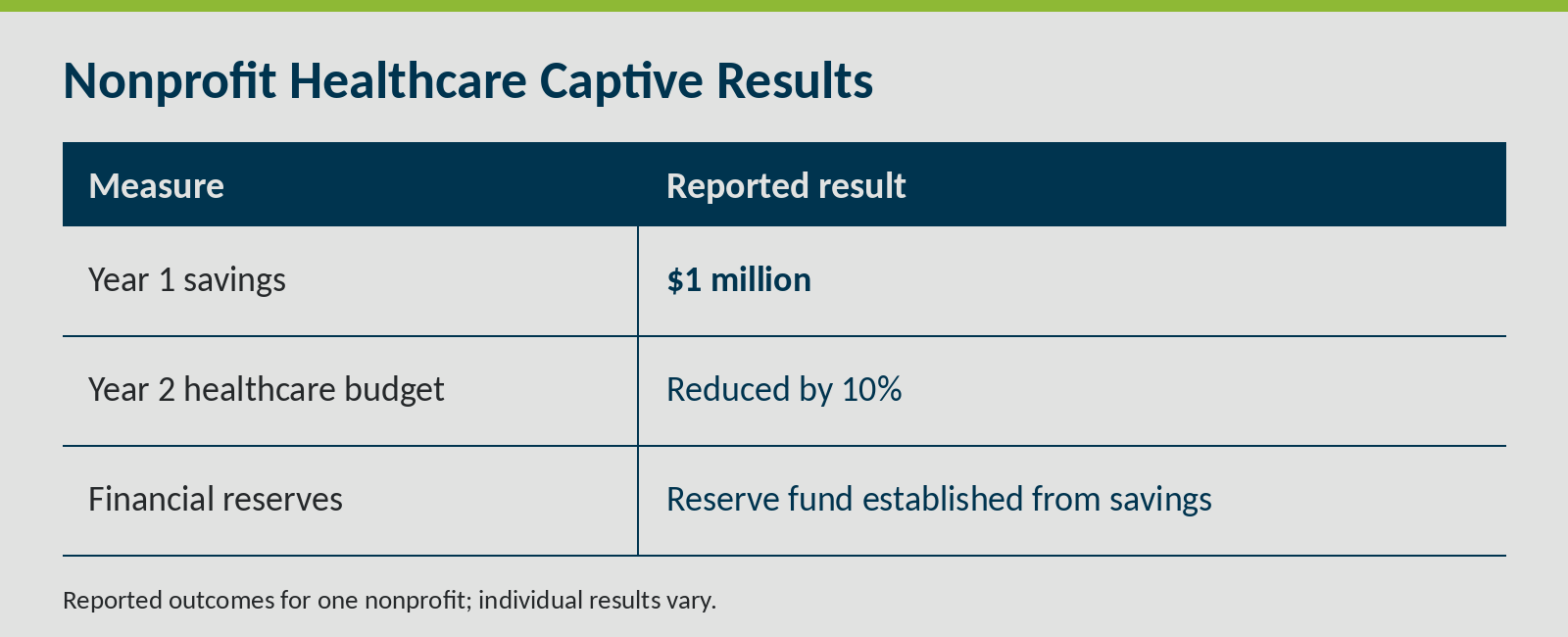
These measures describe different outcomes. The 10% figure represents a healthcare budget reduction in Year 2, not a separately stated dollar savings amount. The case study does not provide enough information to calculate cumulative two-year savings.
Program Context: Eight Years of Historical Performance
Separately from this nonprofit’s results, the case study reports the following PRO Captive program-wide performance for 2018–2025:
• 3.7% average premium-equivalent renewal
• 2.5% average claim trend
• Captive-layer surpluses returned to members in five of eight program years
These are historical program results, not this nonprofit’s individual renewal or claims experience. Surplus distributions and savings are not guaranteed.
Quote: Why the Change Mattered to Employees
“Our employees haven’t had to face increases in their health plan. With cost-of-living increases everywhere, that matters.”
Key Takeaways: Protect the Budget and the Mission
- Look beyond the next renewal. Comparing funding arrangements can help nonprofit leaders consider alternatives to their existing insurance model.
- Make transparency part of the strategy. Claims visibility and clear pharmacy arrangements can support better-informed decisions about healthcare spending.
- Pair funding changes with active risk management. This nonprofit adopted proactive risk management alongside its move to the PRO Captive.
- Consider how savings support financial resilience. The organization established a reserve fund using savings, rather than treating the result solely as a short-term budget improvement.
- Evaluate fit, not just potential savings. A captive’s financial obligations, administrative requirements, and long-term strategy should align with the organization’s needs.
FAQ: Nonprofit Healthcare Captives Explained
What is a healthcare captive for nonprofits?
A healthcare captive is an alternative funding arrangement in which participating employers share certain healthcare risks. OneDigital’s PRO Captive combines a self-funded approach with group participation, giving members greater control and transparency and an opportunity to share in favorable program results. It does not eliminate financial risk.
How did this nonprofit reduce its healthcare costs?
The organization moved from a fully insured plan to OneDigital’s PRO Captive, adopted an unbundled self-funded arrangement with an independent TPA and transparent PBM, and began proactive risk management. The case study reports the overall results but does not quantify the savings attributable to each component.
How much did the nonprofit save?
The nonprofit reported $1 million saved in Year 1 and a 10% healthcare budget reduction in Year 2. It also established a reserve fund using savings. The case study does not state a cumulative two-year savings total.
Does joining a captive guarantee lower healthcare costs?
No. Results depend on factors such as claims experience, plan design, participation terms, and risk management. Historical program performance and one employer’s savings do not guarantee future results or surplus distributions.
Is a healthcare captive right for my nonprofit?
A nonprofit should review its claims experience, workforce needs, funding capacity, risk tolerance, and ability to support ongoing plan management. OneDigital’s evaluation process includes multi-year cost projections and a five-year strategic roadmap to help assess the fit.
Are there options for organizations with fewer than 50 enrolled participants?
Yes. The case study notes that OneDigital offers options for smaller organizations with fewer than 50 enrolled participants. Those employers should ask an advisor about programs designed for their size rather than assume that the same PRO Captive arrangement is available or appropriate.
Related Reading: Explore Captives and Cost Management
• How to Contain Health Plan Costs With Group Captives — An introduction to captive funding, employer responsibilities, and cost-management considerations.
• OneDigital Employee Benefits Captive Solutions — Learn how group captive arrangements share risk and support greater plan transparency.
• OneDigital Impact Studio — Explore workforce investment analysis, funding comparisons, and five-year planning capabilities.
• OneDigital Cost Containment Hub — Find articles, educational resources, and strategies for managing healthcare spending.
Could a different healthcare funding strategy help protect your nonprofit’s mission? Connect with OneDigital’s Captive Solutions team to explore your options: Contact OneDigital.
About OneDigital
OneDigital’s team of fierce advocates helps businesses and individuals achieve their aspirations of health, success and financial security. Our insurance, financial services and HR platform provides personalized, tech-enabled solutions for a contemporary work-life experience. Nationally recognized for our culture of caring, OneDigital’s teams enable employers and individuals to do their best work and live their best lives. More than 100,000 employers and millions of individuals rely on our teams for counsel and access to fully integrated worksite products and services and the retirement and wealth management advice provided through OneDigital Investment Advisors. Founded in 2000 and headquartered in Atlanta, OneDigital maintains offices in most major markets across the nation. For more information, visit onedigital.com.
Disclaimer: This case study is illustrative in nature and highlights the savings of a specific client under particular circumstances unique to them. Your experience may vary depending on your business needs, operating conditions, market conditions and other variables. This is not a guarantee or prediction of future performance or savings for any client. Consult our team to review how our services might apply to your unique situation.