Stop Loss Captives: The Costco Analogy
Author
Article Summary
Stop loss captives can help self-funded employers take a longer-term approach to catastrophic claims risk. By pooling a defined layer of risk, employers may gain greater purchasing leverage, claims transparency, and potential access to surplus distributions when the captive performs well. Learn how stop loss captives work, where savings may come from, and which employers may be a good fit.

When helping self-funded employers evaluate stop loss options, OneDigital looks beyond the next renewal. A stop loss captive is a multi-year risk and financing decision that calls for a clear view of claims experience, risk tolerance, and long-term health plan strategy. The goal isn’t simply a different rate. It is a more accountable approach to managing catastrophic claims risk, with the potential for greater predictability and stability over time.
As advisors, we’re in the thick of every hard conversation about cost, culture, and what “sustainable” really looks like over the next three to five years.
Our job isn’t just to react to a bad renewal; it’s to bring forward structures that align incentives and give employers a more active role in how their dollars are used. That’s exactly where a well-designed stop loss captive fits in.
The Costco analogy helps explain the model. Members join to access buying power and resources that are hard to secure on their own. Similarly, employers in a stop loss captive join a vetted group, pool a defined layer of catastrophic claims risk, and purchase protection above that layer. That structure can strengthen purchasing position, create greater visibility into claims performance, and give employers a more intentional, long-term stop loss strategy.
What Is a Stop Loss Captive?
A stop loss captive is a group captive arrangement for self-funded employers. It allows participating employers to pool a defined layer of catastrophic claims risk rather than purchasing all stop loss coverage independently.
Stop loss insurance protects an employer when covered claims exceed a set threshold. In a captive structure, employers retain their own risk up to an agreed level, share a middle layer of claims risk with other members, and purchase reinsurance for larger catastrophic claims.
The goal is to create more control over the cost, structure, and performance of stop loss coverage.
Why Group Buying Matters
Costco can negotiate differently because it buys at scale. The same principle applies to stop loss captives.
When employers participate in a group captive, they bring together a larger and more diversified risk profile than any one employer may have on its own. That can create stronger purchasing leverage with reinsurers and provide access to resources that may be harder to obtain in a traditional stop loss insurance arrangement.
For self-funded employers, the value is not limited to pricing. Group purchasing can also create more visibility into claims trends, risk management practices, and the factors influencing future healthcare costs.
How Captives Share Risk
A stop loss captive typically sits between the employer’s individual deductible and the point where catastrophic coverage begins.
For example, an employer may retain claims up to $50,000 per covered person. The captive could assume a defined layer above that amount, while the reinsurer covers claims above a higher threshold, such as $250,000.
The exact attachment points, funding levels, and responsibilities vary by captive structure.
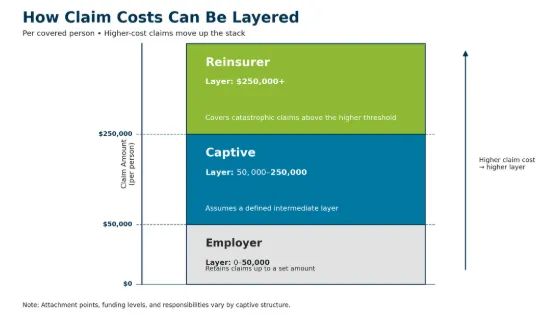
Employers in the captive share that middle layer of risk. That shared approach gives members a direct connection to the group’s claims performance instead of treating stop loss insurance as a cost that disappears at renewal.
Where Captive Savings Come From
In a traditional stop loss arrangement, favorable claims experience may not create a direct financial benefit for the employer. Premium is paid, the policy renews, and the employer starts the process again the following year.
A stop loss captive can create a different outcome
When the group performs well, claims remain within expectations, and the captive has surplus after expenses and reserves, members may receive a distribution based on the terms of the arrangement.
Those returns are never guaranteed. They depend on claims performance, captive expenses, funding requirements, and the participation agreement. Still, the structure gives employers an opportunity to participate in favorable results instead of simply paying premiums with limited visibility into where the dollars go.
Why Transparency Matters
Employers often receive a stop loss renewal quote without a complete view of the claims activity, risk assumptions, and cost drivers behind it. That makes it difficult to determine whether a pricing increase reflects market conditions, plan performance, or a specific claim concern.
Stop loss captives are designed to provide more transparency. Members typically have greater access to claims data, program performance, and the risk factors influencing the captive’s financial results.
That information can support stronger decisions around plan design, clinical programs, specialty drug management, and future stop loss strategy.
Who Is a Good Fit for a Captive?
Stop loss captives are selective by design. A successful group depends on employers that are financially prepared, committed to managing risk, and willing to take a longer view of healthcare costs.
Employers may be a stronger fit when they have:
- A self-funded health plan or are evaluating self-funding
- A stable employee population and sufficient size
- Interest in claims data and healthcare analytics
- A willingness to invest in risk management and clinical strategies
- A multi-year view of stop loss costs and plan performance
A captive is not a fit for every employer. Organizations that need a short-term pricing fix or are not prepared for shared risk may be better served by another stop loss approach.
Taking a Longer View of Stop Loss
The annual renewal cycle can keep employers focused on the next rate increase instead of the underlying factors driving claims and healthcare costs.
Stop loss captives create a longer-term framework.
They encourage employers to look at claims performance, risk management, funding, and cost control as connected decisions rather than separate renewal conversations.
For employers evaluating a stop loss captive, the real question is not whether the model offers a lower first-year rate. It is whether the structure aligns with the organization’s risk tolerance, financial position, health plan strategy, and long-term cost-control goals.
OneDigital helps self-funded employers assess stop loss captive opportunities, evaluate risk, and build a more informed approach to healthcare cost management.
Connect with a OneDigital Benefits Consultant to help your team evaluate captive opportunities in the context of your claims experience, risk strategy, and long-term healthcare cost goals.