The Guidance Gap:
What Employees Actually Need from Retirement Planning
Author
Article Summary
J.P. Morgan's 2026 Retirement Insights survey paints a sobering picture: many employees don't know if they're saving enough, many are tapping their retirement accounts to cover everyday expenses, and nearly three-quarters would hand off their financial decisions if they could. This article breaks down what the data reveals and why workplace financial guidance may be the missing piece.
A workplace retirement plan can give someone access to nearly everything they need: investment options, online calculators, educational webinars, quarterly statements and pages of plan information.
What it cannot give them on its own is clarity.
It cannot tell someone what to prioritize when retirement is competing with credit card debt, rising housing costs or an unexpected medical bill. It cannot tell them whether they are saving enough for their particular goals, or what to do when the amount they should save and the amount they can afford to save are not the same.
That distinction matters because access to financial tools is not the same as knowing how to use them. Information may describe the available choices, but it rarely tells someone which choice makes sense within the context of their life.
J.P. Morgan's 2026 Retirement Insights survey makes that gap difficult to ignore. The findings do more than identify shortcomings in retirement savings. Taken together, they describe a workforce trying to prepare for the future while managing the financial pressures of the present, often without enough personal guidance.
THE VIEW FROM THE OTHER SIDE OF RETIREMENT
Sixty-three percent of retirees surveyed wish they had contributed more to their retirement plans.
That number matters because these are not workers being asked to imagine how they might feel decades from now. These are retirees looking backward, after the consequences of earlier decisions have become clearer.
It would be easy to interpret their regret as evidence that employees simply need to save more. That may be true, but it is incomplete.
Most people already understand, at least broadly, that saving more for retirement is better than saving less. The harder questions are personal: How much more? At the expense of what? Is it better to increase a retirement contribution or pay down debt? How should someone prepare for retirement while also building the emergency savings that may keep them from withdrawing those retirement assets later?
Those are not questions a disclosure or generic savings calculator can fully answer. They require interpretation.
WHEN RETIREMENT ARRIVES BEFORE THE PLAN IS READY
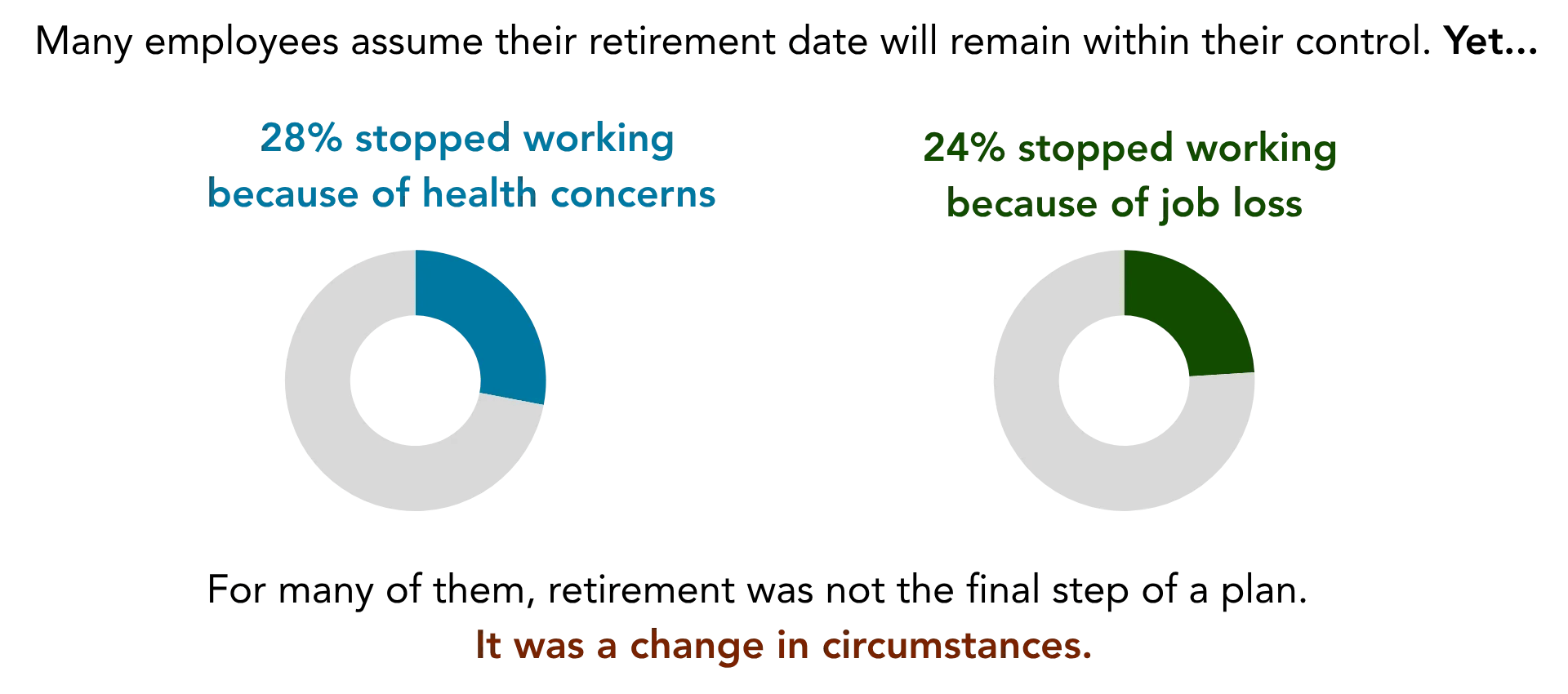
That raises a more useful planning question than simply asking when someone wants to retire: What happens if their working years end sooner than expected?
A retirement projection built around an ideal timeline may provide a sense of direction. A real financial plan must also account for uncertainty. Health changes. Employment changes. Family responsibilities change. The future rarely unfolds exactly as the spreadsheet assumes.
Employees cannot prepare for every disruption. But they can understand the risks, create contingencies and make present-day decisions that leave them better able to absorb the unexpected.
That requires more than a retirement account. It requires a plan surrounding the account.
THE PROBLEM IS NOT A SHORTAGE OF INFORMATION
As more responsibility for retirement planning has shifted to employees, the amount of information provided to them has grown as well. Regulations and disclosures play an important role in protecting participants, but they also contribute to the sheer volume of information employees are expected to consume.
Over half of retirement plan participants say they receive too much plan information to absorb. Nearly half acknowledge that they do not read all the investment information their plans provide.
That may sound like disengagement. It may instead reveal something about the way the retirement industry has historically tried to help people: we have mistaken disclosure for communication, and access to information for understanding.
Yes, plan documents must be comprehensive. Investment disclosures must be precise. Fund fact sheets contain important information. But their completeness does not necessarily make them useful to someone trying to answer a more immediate question: Am I doing the right things with the money I have?
The average employee is not lacking information. What they often lack is the time and context to determine which information matters to them, and what to do with it.
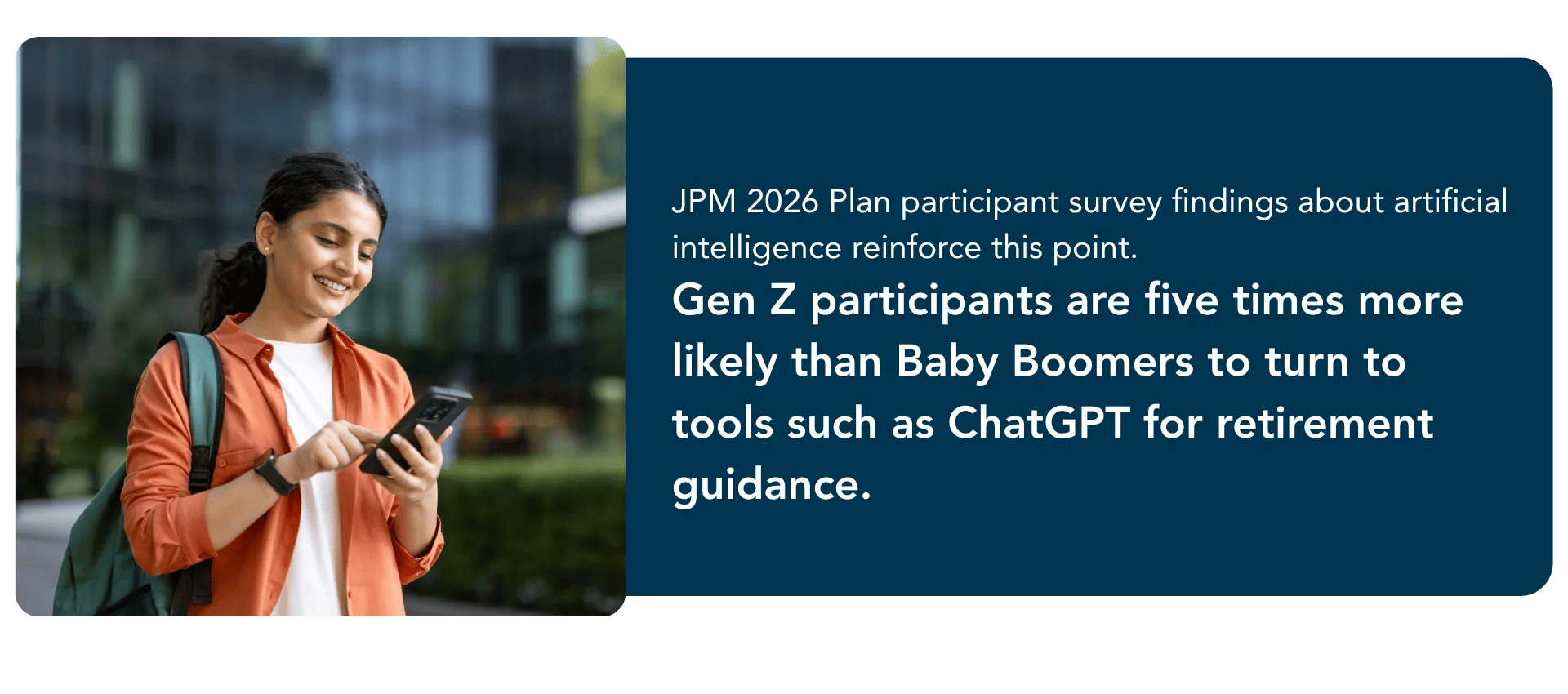
That statistic is less about AI and more about an unmet need. When people do not know where to begin, they turn to whatever feels accessible and capable of giving them a direct answer. Younger workers may not be disengaged from retirement planning, they may be actively looking for something that can translate a complicated financial system into a decision they can understand.
WHEN THE FUTURE COMPETES WITH THE PRESENT
Even the best retirement intentions eventually confront the realities of everyday life, and generic financial information is wholly unsuited to navigating them.
When prices rise, some employees reduce their contributions. Nearly one in three participants has no emergency savings. When an unexpected expense arrives, retirement accounts can begin to look less like long-term investments and more like the only available source of cash.
Among participants who took an early withdrawal, nearly half used the money to pay down credit card debt or cover an unexpected expense.
Those decisions should not be dismissed as recklessness. In many cases, employees are choosing between protecting their future and meeting an immediate obligation. That is a genuinely difficult position, and the long-term cost is real regardless.
Withdrawing $10,000 from a retirement plan can mean losing significantly more once taxes, applicable penalties and forgone investment growth are factored in. But an employee who understands those consequences may still make the withdrawal if no viable alternative is apparent.
That is where education alone reaches its limit. Guidance can help the employee examine the full trade-off, identify alternatives and understand which option may cause the least long-term harm.
The goal is not to pretend difficult financial choices can always be avoided. It is to help people understand the full cost of those choices, recognize the alternatives available to them, and decide which trade-offs make the most sense within their circumstances.

WHAT 73% OF PARTICIPANTS ARE REALLY TELLING US
Nearly three-quarters of participants said they would fully delegate their retirement planning and investing if given the opportunity.
After all the survey has revealed, this is not a surprise. Employees are surrounded by financial information that is difficult to interpret, exposed to circumstances they cannot always control, and expected to prepare for a future they cannot predict. This is not about abdicating responsibility. It is evidence that many of them are asking for help.
THE GUIDANCE GAP
The survey found that participants who work with a financial advisor are more likely to have emergency savings, understand how much they may need for retirement and feel confident about their contribution levels.
The advantage of financial guidance is clear. Access to it has been far less evenly distributed.
Traditional financial advice often reaches people only after they have accumulated enough wealth to seek out, or attract, an advisor. That leaves a significant gap. Many employees need one-on-one help long before they have built substantial assets, when decisions about debt, emergency savings and contribution rates may have the greatest effect on their long-term finances.
The workplace is uniquely positioned to close that gap.
It already connects employees to the retirement plan. It can also connect them to the education and personal guidance needed to make the plan more useful.

HOW ONEDIGITAL HELPS CLOSE THE GUIDANCE GAP
OneDigital's Financial Education & Guidance program is designed to bring financial support to employees earlier in their financial lives, before they might traditionally have access to an advisor.
Financial Academy provides live and on-demand education covering practical topics such as budgeting, debt management, emergency savings and retirement planning. These topics are connected because employees do not experience their financial lives in separate categories. A lack of emergency savings today can become a retirement withdrawal tomorrow.
Education provides the foundation, but it is not the final step.
Through one-on-one financial coaching, employees can apply what they have learned to their own circumstances. An advisor can help someone estimate what they may need in retirement, understand the long-term effect of changing a contribution rate, evaluate the potential cost of a plan loan or decide what to prioritize when several financial needs feel equally urgent.
For participants who want to delegate more of the responsibility, OneDigital's Wealth Management solution offers access to investment management and comprehensive financial planning through OneDigital Investment Advisors LLC.
The purpose is to meet people where they are: educating those who need a starting point, guiding those facing a specific decision and providing ongoing advice to those ready for a more comprehensive relationship.
THE BOTTOM LINE
The J.P. Morgan survey contains a great deal of data, but beneath the numbers is a familiar human tension: people are trying to care for their future without neglecting their present.
Most employees do not need to be convinced that retirement matters. They need help determining what responsible preparation looks like amid competing priorities, imperfect information and circumstances that can change without warning.
Good financial guidance does not remove responsibility from the employee. It makes that responsibility more manageable, helping people understand the choices in front of them, the trade-offs behind those choices and the consequences that may not become visible until years later.
The difference is often not whether someone cares enough to make a good decision. It is whether the right support is available when that decision has to be made.
Historically, the people who could benefit most from financial guidance have often been the least likely to receive it. By bringing that guidance into the workplace, OneDigital can reach employees earlier — when better decisions still have time to shape better outcomes, and before having substantial assets becomes the price of admission.
Learn more about OneDigital's Financial Education & Guidance program
Source: 2026 Plan participant survey findings. (n.d.-b). https://am.jpmorgan.com/us/en/asset-management/adv/insights/retirement-insights/plan-participant-survey/
This article is for informational purposes only and should not be interpreted as specific advice. You should make decisions based on your unique objectives and financial situation. If you are unsure please work with an appropriate advisor to review your specific circumstances. Additionally, any statements made reflect our views and/or opinions and are not intended to guarantee any particular result.
Investment advice offered through OneDigital Investment Advisors LLC.