When Employees Cross Borders, Responsibility Follows
Author
Article Summary
As workforce mobility expands, employers face rising complexity in managing global risk, compliance, and employee protection. A duty-of-care-driven global benefits strategy helps organizations move beyond fragmented programs to improve visibility, mitigate risk, and support employee wellbeing while strengthening operational resilience and long-term business performance.

How Duty of Care Is Reshaping Global Benefits Strategy
As organizations expand across borders, their responsibility to protect and support employees has become both more complex and more consequential. A global workforce introduces new layers of exposure, including uneven healthcare systems, geopolitical uncertainty, evolving regulations, and cultural differences.
What was once viewed as a standard benefits function has evolved into a strategic priority directly connected to organizational risk management, workforce resilience, and sustainable growth.
Why Global Benefits Strategy Is Now a Business Imperative
In today’s environment, global benefits strategy is no longer simply about providing insurance coverage. It is about ensuring continuity of care, operational readiness, and employee protection wherever work occurs.
Organizations that adopt a unified approach grounded in a duty of care philosophy are better positioned to:
- Mitigate organizational and workforce risk
- Enhance employee experience across regions
- Protect financial and reputational outcomes
Rather than managing benefits as disconnected regional programs, leading employers are redefining them as integrated systems aligned with company risk and talent strategy.
How Workforce Mobility Is Increasing Risk Exposure
The modern workforce has changed rapidly. Globalization, remote work, and internationally mobile talent have reshaped traditional employment models.
Employers now support:
- Expatriates and inpatriates
- Short-term assignees
- Frequent business travelers
- Remote employees working across borders
- Locally hired staff in unfamiliar environments
Each population carries distinct risks. However, many organizations still rely on fragmented solutions built over time rather than a unified global strategy.
What Duty of Care Means in Global Workforce Management
Duty of care refers to the obligation to take reasonable steps to protect employees from foreseeable harm. In a global context, this extends far beyond traditional insurance.
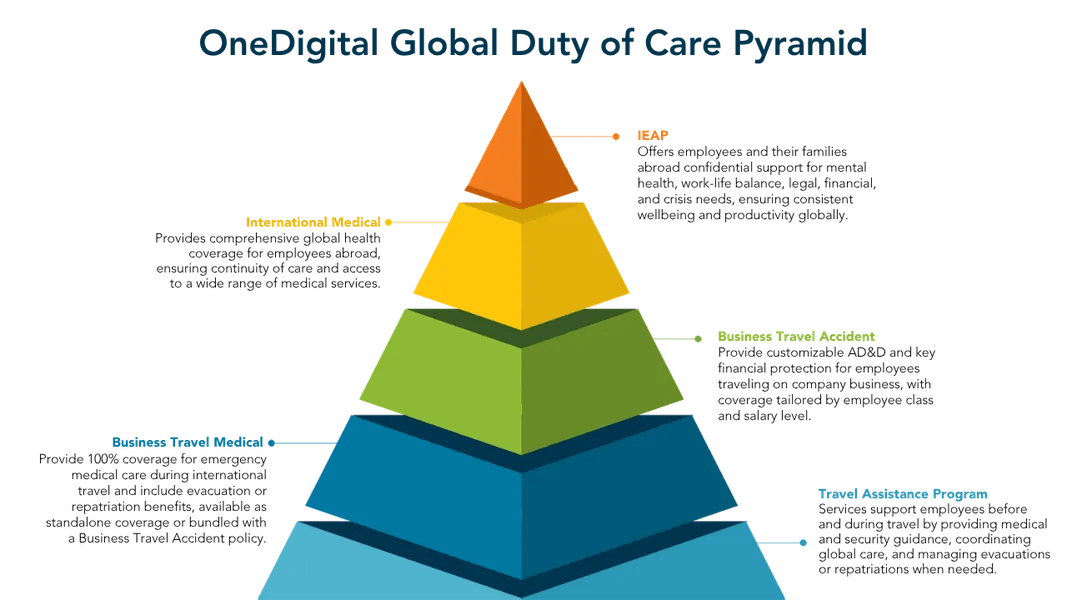
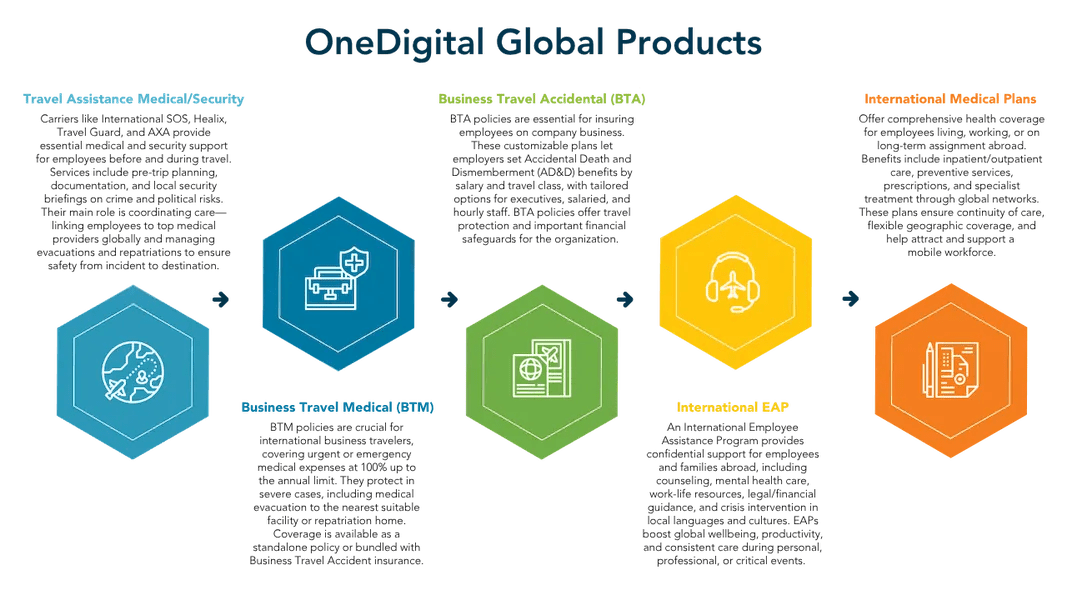
A comprehensive duty of care strategy includes:
- Access to reliable healthcare infrastructure
- Emergency medical evacuation and repatriation
- Crisis response and security support
- Regulatory compliance across jurisdictions
- Preventive education and risk preparation
Employers are increasingly expected not only to respond to incidents but to anticipate and mitigate risks before they occur.
The Risk of Fragmented Global Benefits Programs
A unified global benefits strategy is the mechanism through which duty of care is delivered consistently. Without centralized governance, organizations often develop decentralized programs shaped by local decisions or legacy vendor relationships.
While these may meet regional needs, they often create:
- Inconsistent employee coverage
- Compliance gaps
- Increased financial exposure
Fragmentation remains one of the most common and preventable sources of international risk.
Why Global Healthcare and Risk Variability Matters
Healthcare quality, provider access, and emergency infrastructure vary widely across regions. At the same time, exposure to:
- Infectious diseases
- Natural disasters
- Medication shortages
- Political instability
Can significantly impact employee safety and access to care.
Organizations must move beyond reactive approaches and adopt proactive risk planning supported by global analytics and coordinated guidance.
High-Risk Workforce Segments: Globally Mobile Employees
Globally mobile employees, especially business travelers, represent one of the highest-risk workforce segments.
These employees often operate outside traditional HR visibility while facing elevated exposure to:
- Medical emergencies
- Security risks
- Coverage limitations
A duty-of-care-focused strategy integrates medical, security, and travel risk services into a coordinated system capable of responding quickly and effectively.
Navigating Global Compliance and Regulatory Complexity
Governments worldwide are increasing mandates related to:
- Health coverage
- Employment classification
- Taxation
- Reporting requirements
Compliance failures can result in penalties, operational disruption, and reputational damage.
Organizations benefit from governance models that combine centralized oversight with localized execution, ensuring compliance while maintaining flexibility.
How Employee Expectations Are Changing Globally
Employee expectations are evolving. International assignees and globally mobile professionals increasingly evaluate employers based on the consistency and reliability of benefits support abroad.
Benefits are now a key factor in accepting global roles, reflecting a broader shift in how employees perceive employer responsibility.
Key Components of an Effective Global Benefits Strategy
Organizations that successfully embed duty of care into their strategy typically align around several core principles:
- Centralized governance for visibility and accountability
- Standardized global minimum coverage levels
- Integrated health, security, and travel risk partnerships
- Data and analytics for insight into risk and cost drivers
- Local flexibility to ensure compliance and cultural alignment
This balance between global consistency and regional adaptability signals a mature and effective global benefits program.
Business Impact of a Unified Global Benefits Approach
Aligning global benefits strategy with workforce objectives drives measurable business outcomes, including:
- Improved risk management
- Greater operational efficiency
- Enhanced cost control
- Increased employee confidence and retention
- Stronger employer brand in global markets
Organizations that implement centralized governance and vendor consolidation also benefit from improved transparency and actionable insights.
How to Start Building a Duty-of-Care-Driven Strategy
Organizations do not need to transform overnight. Many begin with practical steps:
- Mapping workforce risk exposure
- Conducting a global benefits gap analysis
- Establishing governance structures
- Defining global minimum standards
- Integrating medical and security partners
- Implementing analytics for ongoing optimization
Incremental progress can deliver meaningful risk reduction while building long-term alignment.
The Future of Global Benefits Strategy
As workforce mobility continues to expand and global risks become more interconnected, global benefits will continue to evolve.
Organizations must move beyond fragmented local programs toward coordinated systems that protect both employees and the enterprise.
Duty of care is no longer just a compliance requirement. It is a strategic framework that aligns employee wellbeing with business continuity and resilience.
Take the Next Step
Organizations that embrace a duty-of-care-driven global benefits strategy reduce risk, support sustainable growth, and demonstrate a clear commitment to their people across every location.
Connect with a OneDigital Global Benefits Expert to evaluate how your global benefits strategy supports workforce protection, compliance, and long-term business performance.