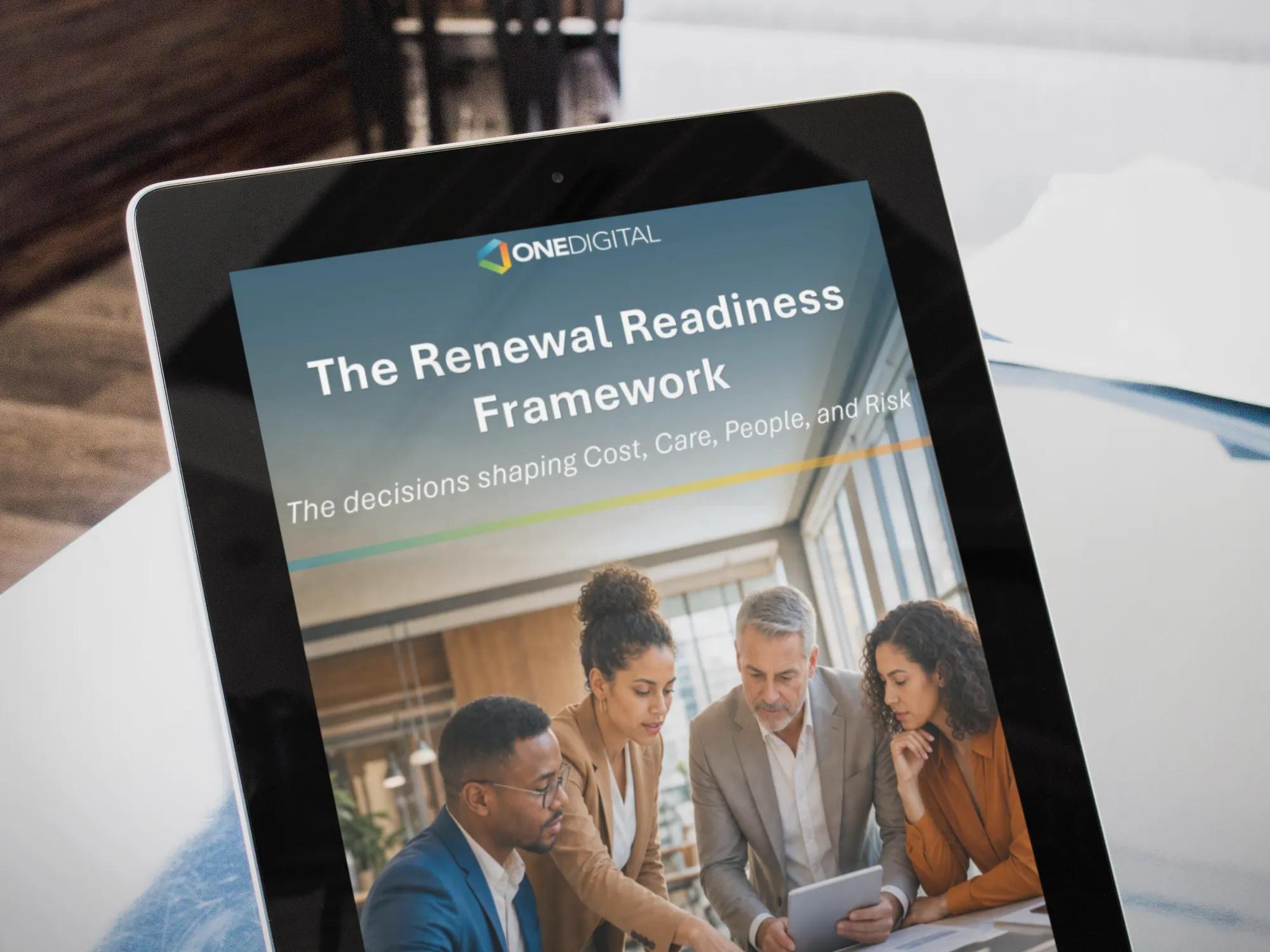
The Renewal Readiness Framework
Stop Reacting to Renewal, Start Influencing It
Employers receiving 20%+ renewal increases are dealing with more than rising costs. They are dealing with decisions that started months earlier.
The Renewal Readiness Framework gives HR leaders, benefits teams, and finance executives a structured way to evaluate the four drivers shaping their next renewal: Cost, Care, People, and Risk, before Q4 pressure forces a reactive response.

Why This Framework Matters
Renewal Outcomes Are Built All Year
Most employers don't realize renewal pressure starts 6–9 months before the carrier quote arrives.
- Fewer than 2% of members can drive nearly half of total plan costs.
- Specialty and pharmacy spend are creating more cost volatility.
- Fully insured employers often lack the data needed to negotiate.
- Compliance gaps and undocumented vendor decisions can quietly compound risk.
The Renewal Readiness Framework brings Cost, Care, People, and Risk together so your team can see what needs attention before decisions become urgent.

What's Inside the Framework
Built for the decisions that shape renewal outcomes.
This framework is designed for employers who want to move from managing renewal increases to understanding, and influencing, what is driving them.
Understand what is actually driving medical and pharmacy spend, before it shows up as a 20%+ increase. Including specialty drug strategy, PBM performance, funding alternatives (fully insured, level-funded, self-funded), and benchmarking your renewal against comparable employers by size, industry, and geography.
Identify the gap between the benefits available and the benefits used. Utilization gaps are cost gaps. Evaluate navigation tool adoption, telehealth integration, preventive care completion, and where delayed care is driving avoidable spend.
66% of employees are financially stressed, and it shows up in care decisions, engagement, and retention risk. Evaluate whether your benefits reflect the actual life-stage needs of your workforce today, not the plan design you inherited three years ago.
ERISA fiduciary scrutiny is expanding into health and pharmacy benefits. In FY2025, the DOL’s Employee Benefits Security Administration recovered more than $1.4 billion for benefit plans and their participants, with more than half tied to enforcement actions. Review vendor oversight, compliance documentation, and your plan governance posture before renewal.
Get the Insights You Need to Strengthen Renewal Readiness
Renewal outcomes are shaped long before the carrier delivers an increase. Explore the framework to understand how decisions across cost, care, people, and risk influence your benefits strategy, and what your organization can do now to prepare.
20%+ Initial Renewal Increases
Many employers are receiving initial renewal increases of 20% or higher.Claims experience, pharmacy trend, and carrier pricing strategies can push renewal increases beyond published trend figures. Greater visibility into cost drivers can help employers identify opportunities before renewal pressure builds.
73% Want More Benefits Education
Nearly three in four employees want more education on company benefits.Programs only create value when employees understand, trust, and use them. Better benefits communication can improve utilization, reduce confusion, and help employees access the resources already available to them.
66% Financially Stressed
Two-thirds of employees are experiencing financial stress.Financial stress can affect health, mental wellbeing, engagement, and overall business performance. Renewal readiness should account for the workforce needs employees are managing today.
$1.4B+ Recovered by EBSA
Regulators recovered more than $1.4 billion for benefit plans and participants in FY2025.Strong governance, documentation, and vendor accountability can help employers stay audit-ready and reduce the risk of penalties, litigation, remediation work, and operational disruption.
Frequently Asked Questions
Renewal readiness is the discipline of reviewing the decisions, data, and risks that shape renewal outcomes, before the carrier quote forces a reactive response. It includes evaluating healthcare and pharmacy spend drivers, employee benefit utilization, workforce needs, vendor performance, and plan compliance posture throughout the year, not just at renewal.
HR leaders, benefits directors, finance leaders, operations executives, and business owners involved in benefits strategy and renewal planning, especially those preparing for plan design changes, funding strategy evaluations, vendor reviews, or market checks.
Ideally, 90–180 days before your renewal effective date. Earlier if you are considering self-funded or level-funded alternatives, a PBM carve-out, or a market check. The framework includes a quarter-by-quarter calendar to guide the full year.
Cost (healthcare and pharmacy spend drivers, funding strategy, benchmarking), Care (utilization, navigation, telehealth, employee engagement), People (workforce needs, financial wellbeing, retention risk), and Risk (ERISA fiduciary governance, HIPAA compliance, vendor accountability, documentation).
No. The strongest renewal outcomes are built year-round. This framework is designed to be used as a 12-month operating cadence, with specific decisions mapped to each quarter.
Download Your Framework