How to Measure AI Productivity
Introducing the Workforce Intelligence Score
Authors
Article Summary
AI adoption is up — but is your workforce actually more productive, or just busier? Learn how the Workforce Intelligence (WI) Score measures AI's real impact using data you already have, plus how to calculate your organization's AI Amplification Factor.
Every leadership team has invested in AI. Fewer can say, with real confidence, what that investment has actually produced.
The dashboards show adoption: logins, licenses, usage rates climbing quarter over quarter. What they don't show is whether that adoption is translating into a workforce that's genuinely more effective — or one that's simply generating more output, faster, without getting any smarter about how the work gets done. Busy and better look identical on a usage report. They are not the same thing, and most organizations don't yet have a way to tell them apart.
Why Doesn't AI Adoption Show Up in the Numbers?
This is the question CFOs are asking with increasing urgency: spend on AI tools has roughly doubled at many firms over the past 18 months, and the productivity metrics on the quarterly slide have barely moved. The instinct is to conclude the technology isn't working.
The more likely explanation is that adoption and effectiveness are being measured as if they're the same thing. A workforce can hit 90% license utilization while every employee still uses AI as a one-off question-and-answer tool — what researchers call transactional use. That's very different from a workforce where people are working through multi-step problems with AI, or where AI is functioning as a genuine collaborator inside the workflow. Same spend, same headline adoption number, very different return.
How Can HR Leaders Measure AI Effectiveness, Not Just Usage?
This is the parallel question people leaders are asking: engagement surveys and license reports tell you who's logging in, not how the work itself is changing. What's missing is a way to measure the quality of AI use — how collaboratively people are actually working with it — and connect that behavioral shift to the business outcomes the leadership team already tracks.
That connection is what the Workforce Intelligence Score is built to make.
What Is the Workforce Intelligence Score?
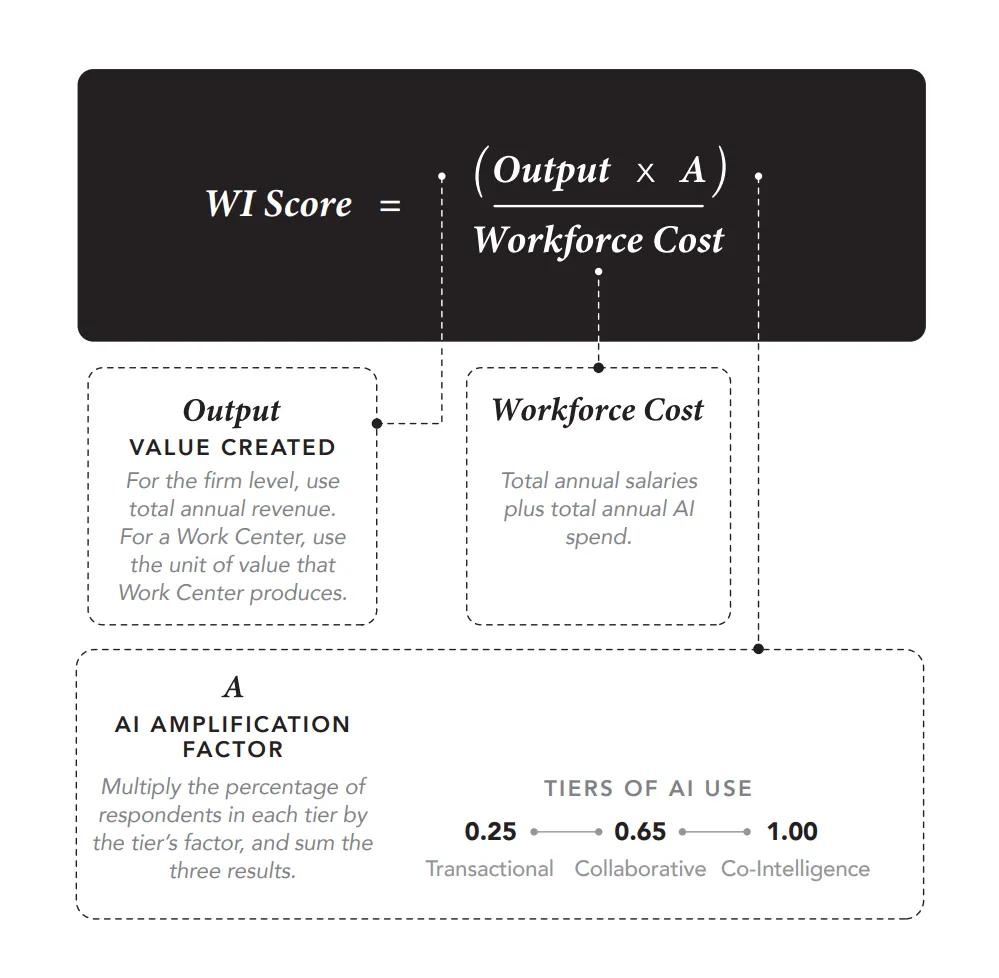
The Workforce Intelligence (WI) Score is a formula that pairs your organization's existing productivity metric with a measure of how collaboratively your workforce actually uses AI, so the two numbers move together instead of being reported separately.
At its simplest, the score takes your firm's output — revenue, renewals, cases closed, whatever your leadership team already reports quarterly — and adjusts it by an AI Amplification Factor that reflects how your people are actually engaging with AI day to day. The full version of the formula, including how it accounts for AI spend and workforce cost over time, is laid out in OneDigital's new book, Workforce Intelligence: The People-First Playbook for Leading Your Company Through AI Transformation. But the core mechanism is simple enough to calculate with data you already have.
How Do You Calculate the AI Amplification Factor?
The Amplification Factor comes from a single survey question asked across the workforce: when you use AI at work, which best describes you?
Respondents fall into one of three tiers, each carrying its own weight:
| Tier | Transactional | Collaborative | Co-Intelligence |
|---|---|---|---|
| What it looks like | Asking a question, using the answer, done | Working through a problem across multiple exchanges | AI functioning as a genuine team member |
| Weight | .25 | .65 | 1.00 |
Multiply the percentage of your workforce in each tier by that tier's weight, and sum the three results.
A workforce that's 60% Transactional, 30% Collaborative, and 10% Co-Intelligence produces an Amplification Factor of 0.445: (0.60 × 0.25) + (0.30 × 0.65) + (0.10 × 1.00). That single number — somewhere between 0 and 1 — tells you where your organization sits on the behavior that predicts whether AI investment shows up in results.
What Does a Rising vs. a Flat Score Actually Mean?
This is the number that belongs next to EBITDA on the leadership slide, because it isolates something a CFO can't manufacture with layoffs, price increases, or accounting adjustments. The Amplification Factor only moves when the people in the workforce genuinely change how they relate to AI.
A rising WI Score means the organization is compounding intelligence into its work — getting smarter. A flat score, even alongside heavy AI spend, means the organization is getting busier, not better. That distinction is the whole point of the metric.
Calculate Your Own Score
The methodology above is the starting point. Workforce Intelligence: The People-First Playbook for Leading Your Company Through AI Transformation, from OneDigital's Mike Sullivan and Vinay Gidwaney, lays out the full calculator — benchmarked against data from more than 100,000 employers — along with the leadership framework for what to do once you know your number.
Visit the Workforce Intelligence page to learn more about the book and connect with a OneDigital advisor to talk through what your organization's WI Score might look like.